
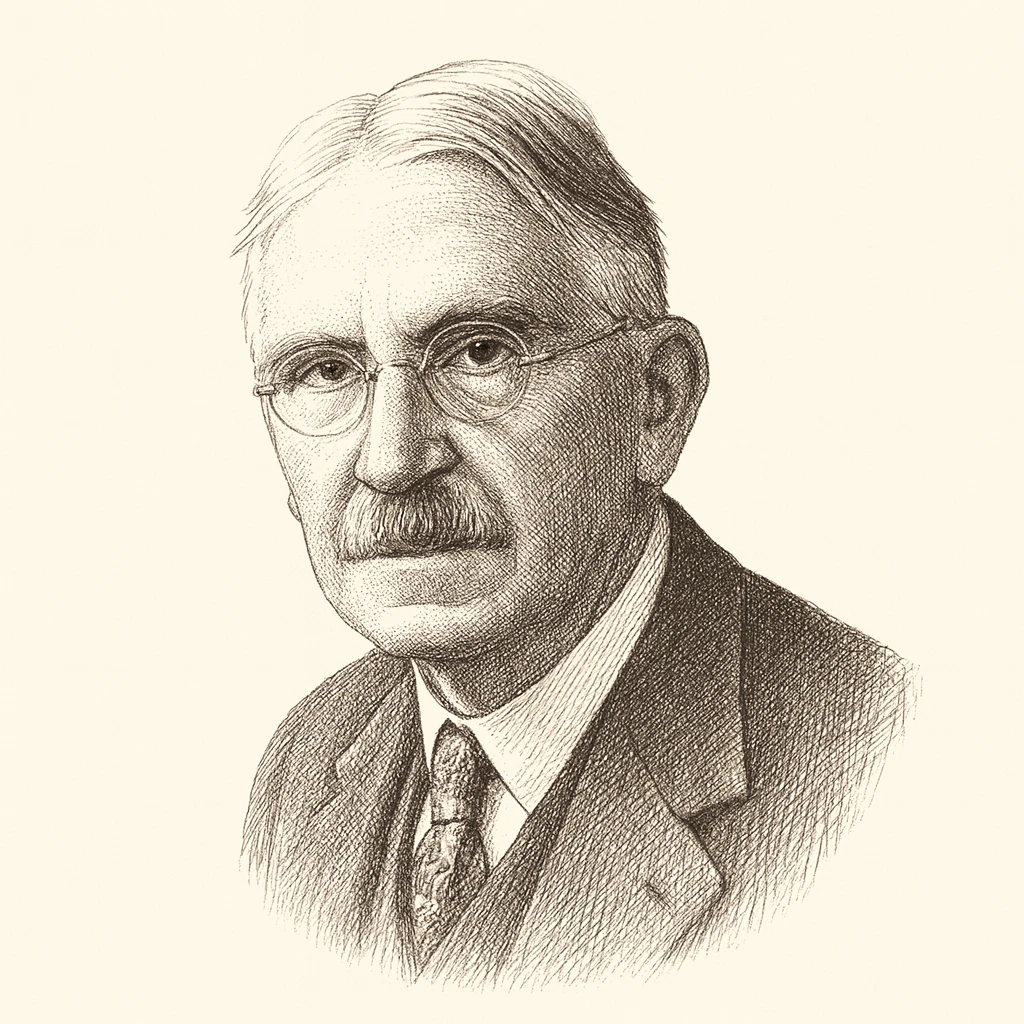
John Dewey was the most influential American philosopher of the first half of the 20th century, a public intellectual whose work reshaped education, political theory, psychology, and the broader American liberal tradition. He wrote on an astonishing range of topics across nearly seven decades of active publishing, intervened in major political debates of his era, and died in 1952 at ninety-two having spent his entire adult life arguing that democracy was less a form of government than a way of life — an ongoing experimental process through which human beings together worked out how to live well.
Dewey was born in 1859 in Burlington, Vermont, educated at the University of Vermont, and began his philosophical career in the 1880s writing in the idealist tradition then dominant in American philosophy. His philosophical maturation came through his engagement with the new discipline of psychology and through his reading of William James, whose Principles of Psychology (1890) Dewey later called "the first book I had ever read about philosophy that made me feel that philosophy could actually be about things." Through James and the broader pragmatist movement that James and Charles Sanders Peirce had founded, Dewey came to see philosophy as an instrument for solving concrete human problems rather than as a search for eternal truths.
Dewey's pragmatism is often misunderstood as a kind of crude expediency — as if "whatever works" were its entire content. The actual view was much richer. Dewey argued that ideas, concepts, theories, and institutions are all tools that human beings develop to navigate their environments. Their value lies not in corresponding to some eternal Platonic realm but in enabling us to anticipate, control, and transform the circumstances we find ourselves in. This applied to scientific theories, moral frameworks, educational methods, and political institutions alike. Good ideas are ones that work, in the rich sense of enabling fuller human lives; bad ideas are ones that fail this test. But what "works" has to be evaluated by people with real experience, real values, and real stakes in the outcome. This is why Dewey came to see democracy as philosophically central. Democracy was the political form most compatible with pragmatism because it made the ongoing evaluation and reconstruction of ideas and institutions a shared social project rather than the prerogative of experts or elites.
Dewey's most famous practical work was in education. His founding of the Laboratory School at the University of Chicago in 1896 was an attempt to translate his philosophical convictions into educational practice. He argued against the then-dominant model of education as the transmission of fixed bodies of knowledge from teacher to student, and for an alternative model in which students learned by actively engaging with problems, experimenting, reflecting, and revising. His book Democracy and Education (1916) laid out this framework systematically and became one of the foundational texts of progressive education throughout the 20th century. Contemporary debates about student-centered learning, experiential education, and project-based curricula still operate largely within the framework Dewey established.
Dewey's political writing ran throughout his career and intensified in his later years. He was deeply involved in American liberal and progressive politics, helped found the American Civil Liberties Union and the NAACP, and wrote extensively on the challenges facing democracy in an age of mass media, corporate power, and technological change. The Public and Its Problems (1927) was his most sustained work of political philosophy, arguing that democracy required the active formation of publics capable of identifying shared problems and working collectively toward their solution, and that modern conditions were making this increasingly difficult. His later book Liberalism and Social Action (1935) was a defense of what he called "radical liberalism" — a liberalism committed to the values of individual liberty and democratic participation but willing to use positive state action to secure the conditions under which those values could be realized in practice.
Dewey died in 1952 in New York at ninety-two. His influence on 20th century American thought is difficult to overstate. Progressive education, democratic theory, pragmatist philosophy, civil liberties advocacy, and mainstream American liberal thought all bear his imprint. He has been read by later generations as both too optimistic about democracy and not optimistic enough, depending on who is doing the reading, and the arguments about his legacy continue.
John Dewey is associated with Social Liberal. See the archetype