
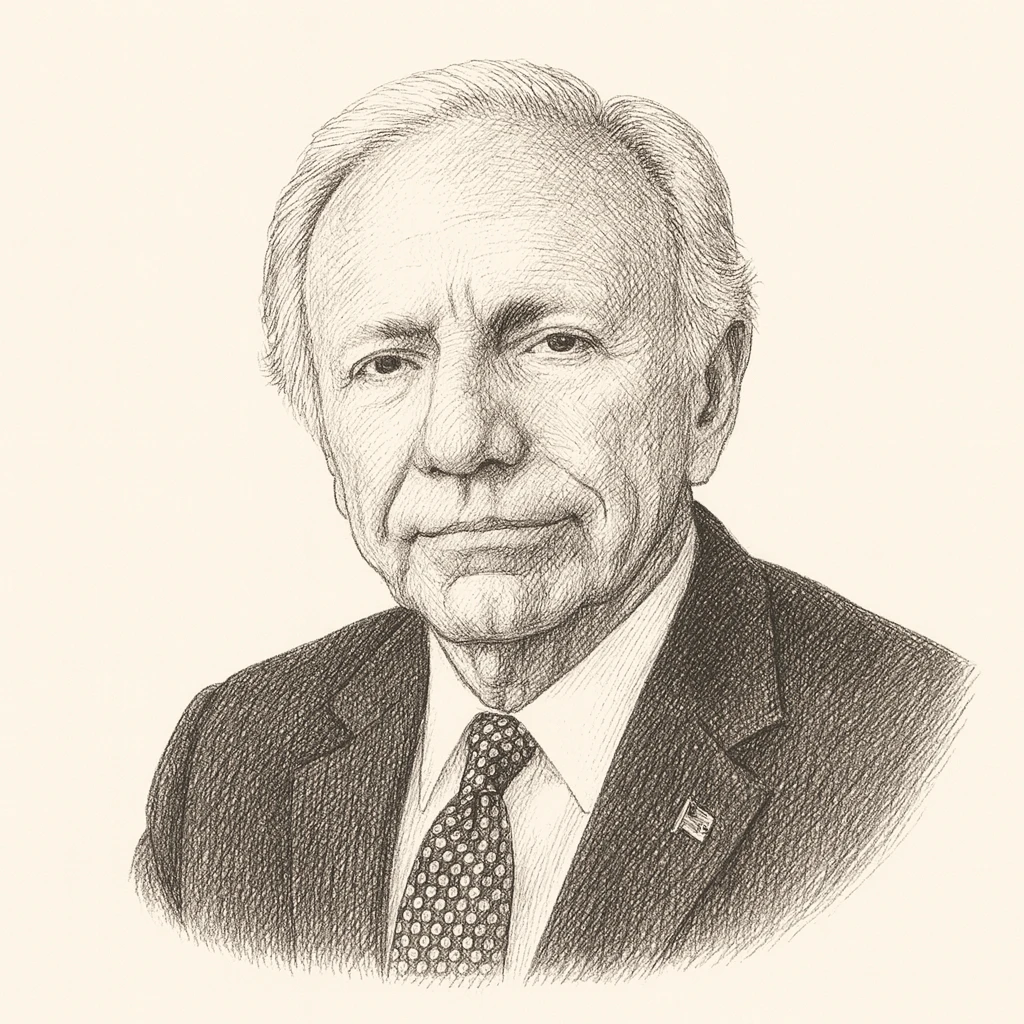
Joseph Lieberman (1942–2024) built a political identity around the idea of moderate, centrist politics anchored in personal conviction and bipartisan cooperation. Representing Connecticut in the U.S. Senate for four terms beginning in 1989, he became one of the most prominent centrist Democrats of his era, associated with the New Democrat movement that sought to move the party toward the political middle on economic and social questions. His selection as Al Gore's vice-presidential running mate in 2000 made him the first Jewish candidate on a major American presidential ticket, and he frequently spoke about faith and moral seriousness as legitimate components of public life.
Lieberman's political thought was most distinctive—and most controversial within his own party—on questions of foreign policy and national security. He was a consistent and vocal supporter of an assertive, interventionist American posture, backing the Iraq War and remaining one of its most steadfast defenders even as opposition mounted among Democrats. This hawkishness aligned him with a tradition sometimes described as liberal internationalism or muscular liberalism, which held that American power should be used actively to defend democratic values and confront threats abroad. His stance ultimately cost him the 2006 Democratic primary in Connecticut, after which he won reelection as an independent, formally styling himself an Independent Democrat.
In his later years Lieberman became a leading voice for a self-consciously post-partisan style of politics. He endorsed Republican John McCain in the 2008 presidential race and became a prominent figure in No Labels, an organization dedicated to promoting bipartisanship, centrism, and cooperation across party lines. Through this work he articulated a critique of hyper-partisanship and political polarization, arguing that governance required compromise and that the two-party system had grown too rigid and ideologically pure to solve national problems.
Lieberman's broader significance lies in how he embodied and defended the political center at a moment when it was contracting. To admirers he represented principled independence and a willingness to break with party orthodoxy; to critics he exemplified how centrism could shade into support for policies—particularly on war and security—that many liberals came to reject. His career became a frequent reference point in debates about whether a durable moderate, bipartisan tradition could survive in an increasingly polarized American politics.
Joe Lieberman is associated with Pragmatic Centrist. See the archetype