
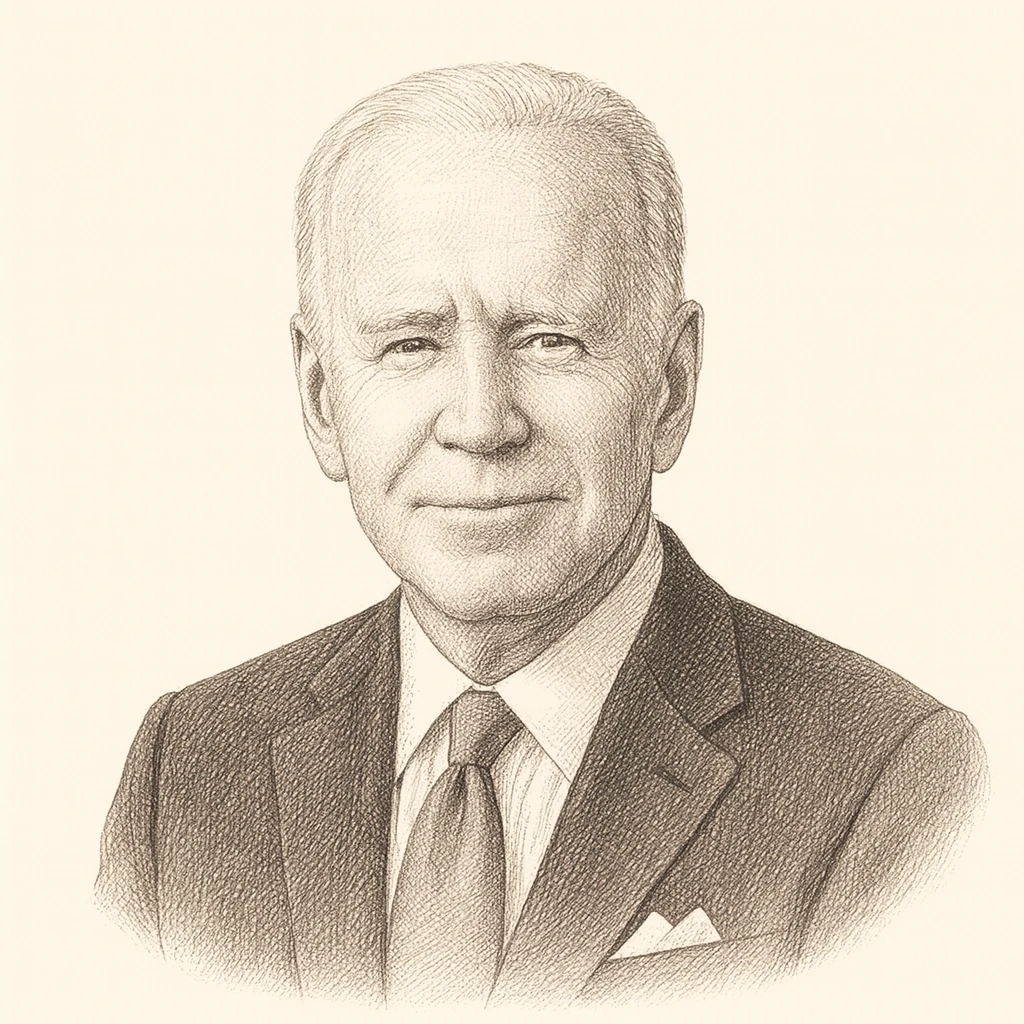
Joe Biden's political thought is defined less by a distinctive ideology than by a deep faith in institutions, incremental reform, and the possibility of cross-party bargaining. Entering the U.S. Senate in the early 1970s and serving there for more than three decades, he built a reputation as a pragmatic Democrat who worked the machinery of government—committees, floor negotiations, and personal relationships—rather than pursuing sweeping theoretical projects. His long tenure chairing the Judiciary and Foreign Relations committees shaped his self-image as a legislator who valued procedure, coalition-building, and the norms of American constitutional government.
Ideologically, Biden has generally occupied the pragmatic center of the Democratic Party, tacking with its center of gravity over time. In earlier decades he supported tough-on-crime measures and welfare and budget compromises that reflected the party's centrist turn; later, as vice president under Barack Obama and then as president, he embraced a more expansive role for government in economic life, backing large public investment, industrial policy, and expanded social spending. This evolution illustrates a recurring feature of his thought: a preference for meeting the political moment through negotiated, achievable measures rather than fixed doctrine.
Biden's presidency (2021–2025) was often framed, including in his own rhetoric, as a defense of democratic institutions and a restoration of governing norms against what he characterized as authoritarian and populist threats. He cast American politics as a contest between institutional stability and its erosion, and positioned bipartisan governance—however difficult in a polarized era—as both a practical necessity and a moral good. The objections to this approach came from both directions: that its incrementalism was inadequate to structural problems, and that its expansion of the federal role went too far; his handling of foreign policy, immigration, and economic questions remains contested.
His lasting significance as a political thinker lies in this institutionalist center-left synthesis: the conviction that liberal ends are best pursued through the slow, compromised work of democratic institutions, and that preserving those institutions is itself a central political task. In an era of rising polarization, Biden represents a bridge between an older consensus politics and a more fractured landscape.
Joe Biden is associated with Moderate Liberal. See the archetype