
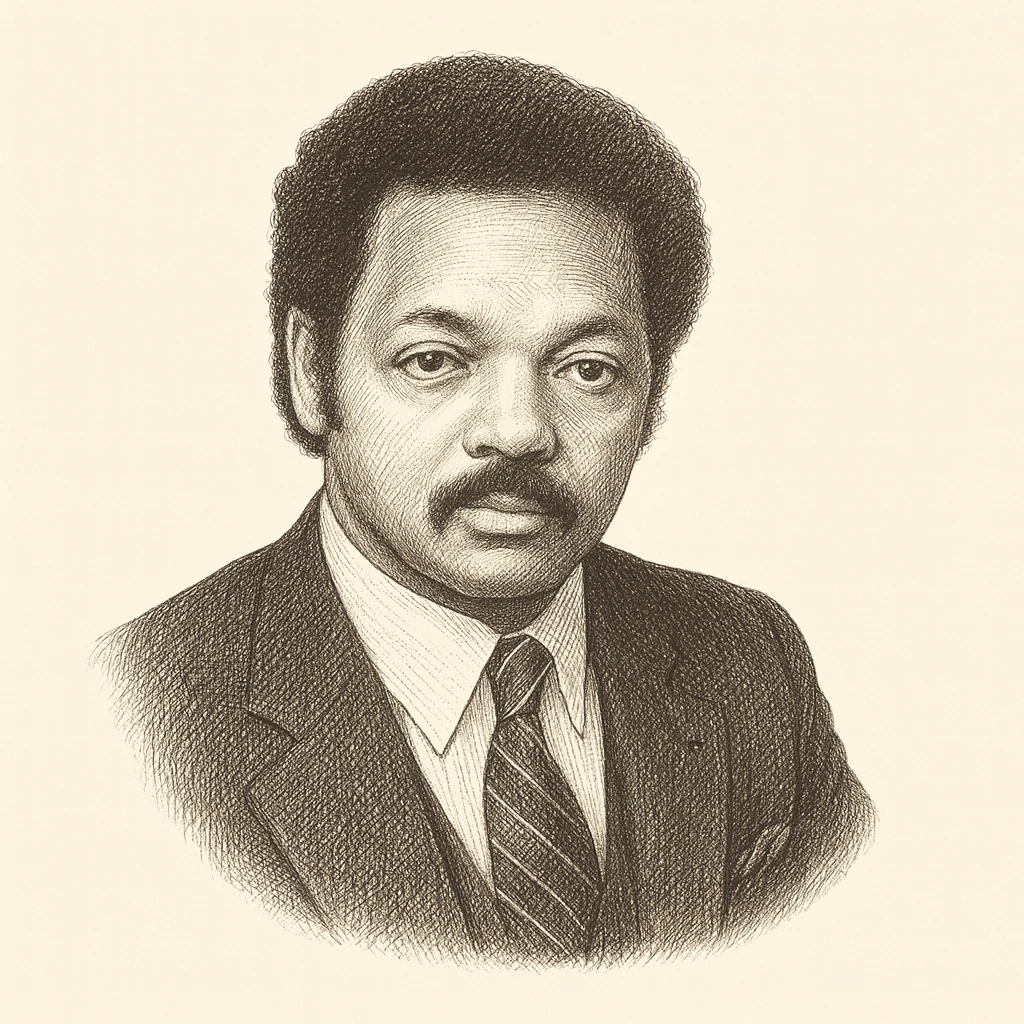
Jesse Jackson emerged from the civil-rights movement, having worked alongside Martin Luther King Jr. in the Southern Christian Leadership Conference before founding his own organizations, most notably Operation PUSH and later the Rainbow Coalition. His political thought fuses the moral vocabulary of the Black church with a program of economic justice, framing poverty, unemployment, and unequal access to capital as civil-rights questions rather than merely matters of formal legal equality. Jackson consistently argued that the unfinished business of the movement was economic: fair wages, jobs, corporate accountability, and access to credit and ownership for those long excluded.
His most influential contribution to American political imagination was the idea of the "Rainbow Coalition" — a vision of an electoral majority assembled from the marginalized across racial and class lines. Black voters, Latinos, poor whites, working people, women, and others were, in Jackson's telling, natural allies whose combined numbers could reshape the Democratic Party. Through two presidential campaigns in the 1980s, he demonstrated that a Black candidate running on an explicitly progressive platform could win substantial primary support, register large numbers of new voters, and force party debates toward questions of poverty and inclusion. He pressed for greater representation of racial minorities within party structures and for a foreign policy more critical of apartheid and militarism.
Jackson's method combined mass mobilization, moral suasion, and direct negotiation, sometimes conducting freelance diplomacy to secure the release of detainees abroad. Critics from the right and center faulted his rhetoric and questioned the durability of his organizations, and his career has drawn scrutiny over remarks including his 1984 reference to Jews and New York City as "Hymietown," for which he later apologized, and over the management and finances of the groups he led. Yet his enduring significance lies in showing that protest-derived politics could scale into electoral coalition-building, and that a candidate outside the establishment could expand the electorate and shift a major party's agenda. Later multiracial progressive coalitions, and the plausibility of insurgent primary campaigns rooted in movement organizing, owe a clear debt to the template he built.
Jesse Jackson is associated with Progressive Activist. See the archetype