
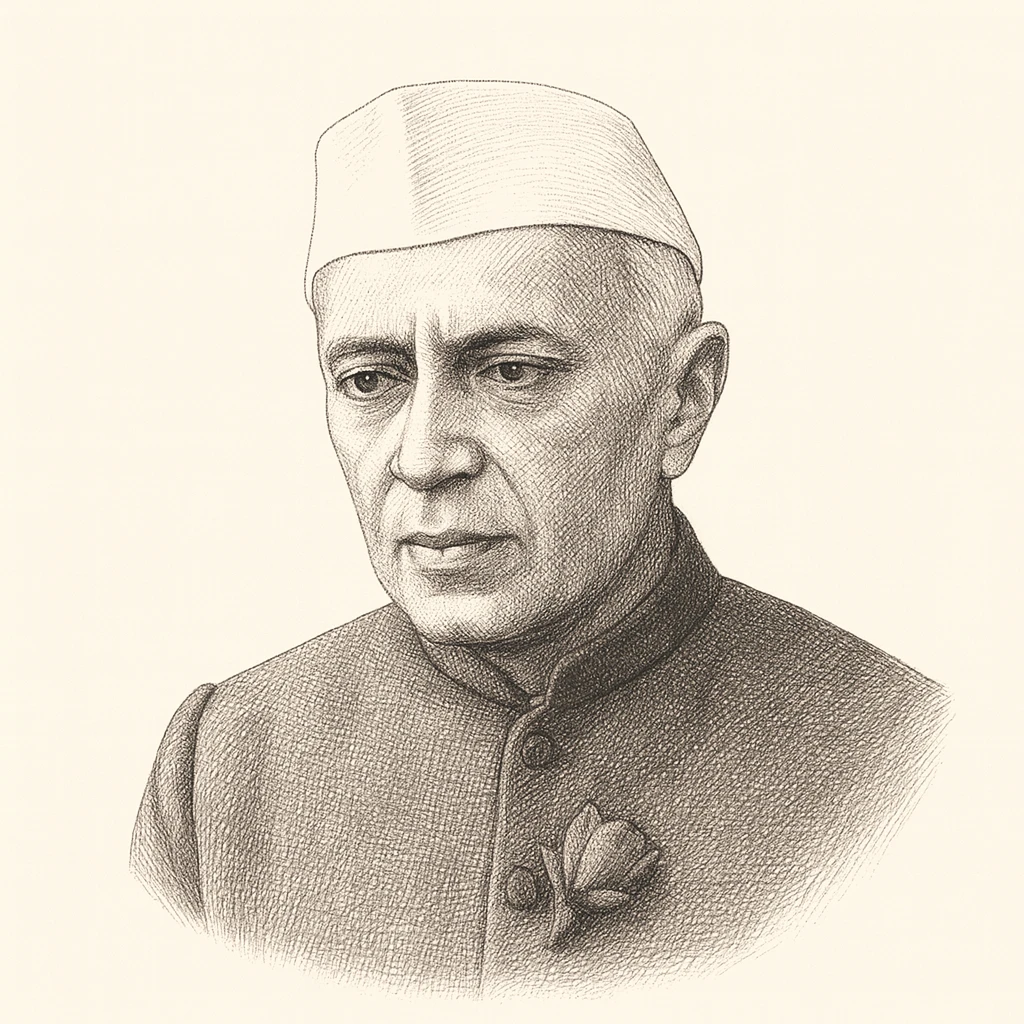
Jawaharlal Nehru was independent India's first Prime Minister, serving from 1947 until his death in 1964 and shaping the nation's democratic, secular, and socialist character. Educated at Harrow and Cambridge, Nehru joined Gandhi's independence movement, spending years in British prisons while emerging as Congress Party leader. During those imprisonments he wrote historical and autobiographical works, including The Discovery of India.
Nehru's vision for India combined Western parliamentary democracy with socialist economic planning and Hindu-Muslim secularism. Drawn to the Fabians as a young man and impressed by Soviet Russia, though he disliked its suppression of dissent, he built a mixed economy: a large public sector in heavy industry and infrastructure alongside private enterprise, coordinated by the Planning Commission. His five-year plans emphasized heavy industry and state enterprise, and at the Bhakra-Nangal dam in 1954 he likened such projects to the temples of a new India. He defended his secularism against Hindu nationalism and communal politics.
Abroad, Nehru argued that newly decolonized states need not join either Cold War camp. The Non-Aligned Movement, which he co-founded with Tito and Nasser among others, kept India independent of both blocs and promoted peaceful coexistence and anti-colonial solidarity across Asia and Africa. His governments established democratic institutions and regular elections under universal suffrage, promoted education and science, and held together a country of enormous diversity.
Growth under planning was slow; the economist Raj Krishna later called India's post-independence pace the "Hindu rate of growth," and the licensing controls that grew from state direction of industry became known as the "Permit Raj." India's defeat in the 1962 border war with China was followed in November by the resignation of his defense minister, V. K. Krishna Menon, and shadowed Nehru's final years. His daughter Indira Gandhi and grandson Rajiv Gandhi later became prime minister, and the Nehru-Gandhi family dominated Indian politics for decades.
Nehru's framework remained the reference point of Indian politics after his death: extended by his successors, largely dismantled by the market liberalization of the 1990s, and opposed by Hindu-nationalist critics of his secularism.
Jawaharlal Nehru is associated with Democratic Socialist. See the archetype