
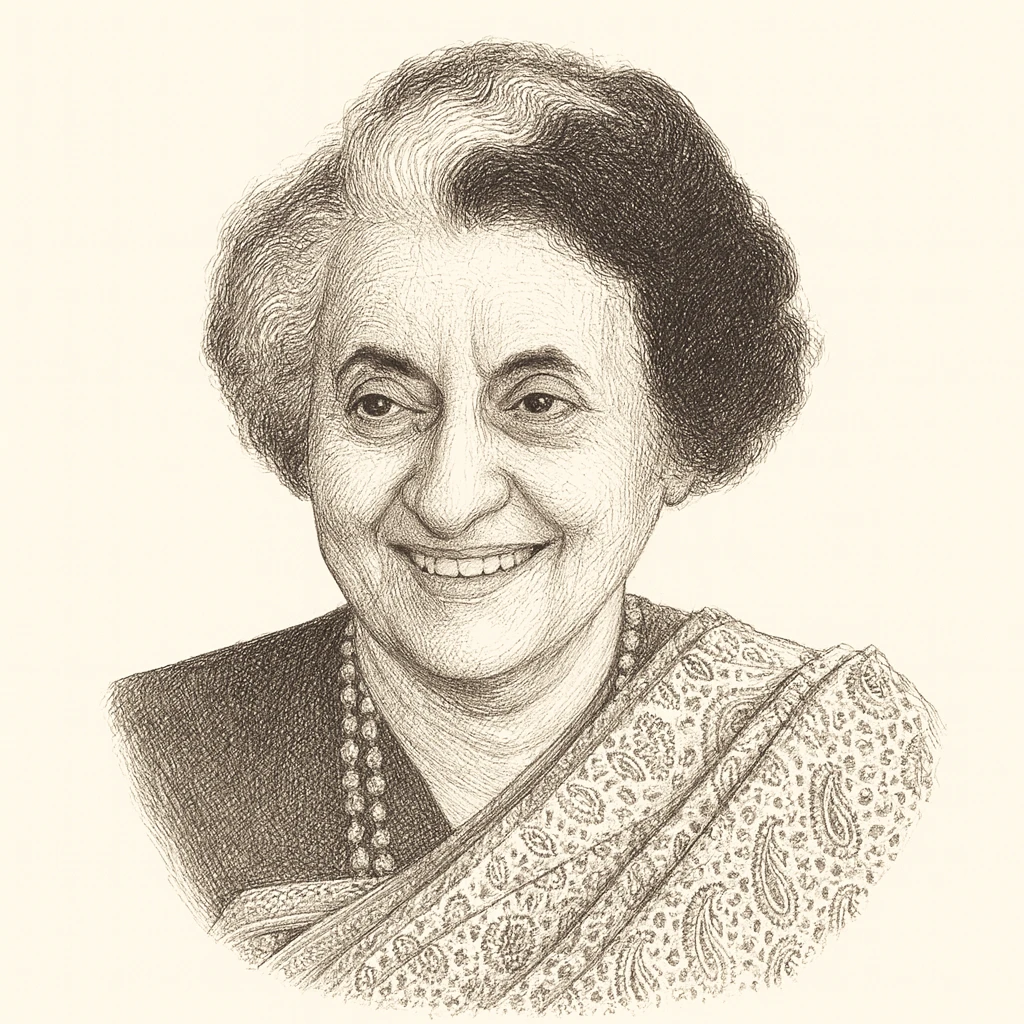
Indira Gandhi was India's third Prime Minister, holding the office from 1966 to 1977 and again from 1980 to 1984, and its most powerful leader since independence. Her Emergency rule (1975-1977) suspended civil liberties across the country. The daughter of Jawaharlal Nehru, Indira married Feroze Gandhi (no relation to Mahatma) and rose through Congress Party ranks. She owed her selection to a group of party bosses known as the Syndicate, who expected her to follow their advice; she sidelined them, split the Congress in 1969, and set out to build an independent nationwide base of support.
Her politics combined socialist economic policy with populist mobilization. The 1969 nationalization of 14 private banks was justified as a way to spread credit across the country, and it belonged to a program that stressed the growth of the public sector. Her slogan 'Garibi Hatao' (Abolish Poverty) mobilized India's poor; with it she sought support among landless laborers, Dalits and Adivasis, minorities, women, and unemployed youth. By the early 1970s opposition parties objected that politics was becoming too personalized and that governmental authority was being turned into her personal authority.
Her governments oversaw the 1971 war that created Bangladesh, the Green Revolution that ended Indian famine, nuclear weapons development, and the nationalization of banks. Abroad, her government signed a treaty with the Soviet Union in August 1971.
In 1975, facing a court ruling against her election and mounting opposition agitation, she declared a state of Emergency: she suspended civil liberties, imprisoned opponents, censored the press, and ruled by decree, citing a threat of internal disturbance. Forced sterilization campaigns and slum clearances, associated with her son Sanjay, provoked wide popular anger. She lost the subsequent 1977 election but returned to power in 1980. Her military assault on the Golden Temple to remove Sikh militants led to her assassination by Sikh bodyguards in 1984, and her son Rajiv succeeded her as Prime Minister.
The Janata government that replaced her in 1977 passed the 44th Amendment (1978), which replaced 'internal disturbance' with 'armed rebellion' as a ground for declaring an emergency.
Indira Gandhi is associated with Left Nationalist. See the archetype