
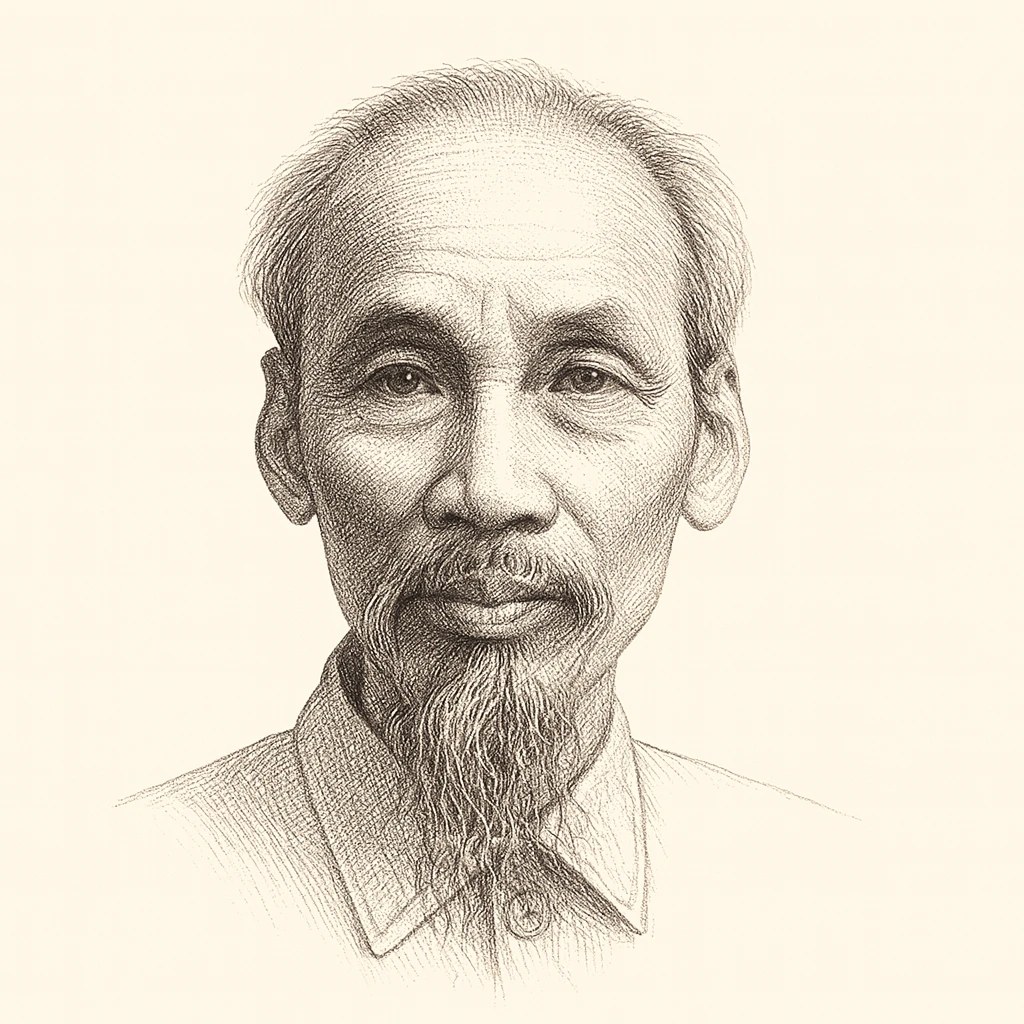
Ho Chi Minh was the founder of modern Vietnam, whose communist revolution defeated French colonialism and American intervention. Born Nguyen Sinh Cung, Ho traveled the world, living in Paris, London, Moscow, and China, before returning to lead the Vietnamese independence struggle for over three decades. His early political awakening came in France, where he petitioned the 1919 Versailles peace conference for Vietnamese rights without result and in 1920 became a founding member of the French Communist Party, drawn to Lenin's views on imperialism.
Ho's political thought synthesized communism with Vietnamese nationalism. Ho held that in a colonized country national liberation had to come before socialist revolution. His 1945 Declaration of Independence quoted Jefferson and the French Revolution, appealing to the universalist language of the very powers he opposed. He sought American support against France, but Cold War dynamics pushed him toward the Soviet bloc. The Viet Minh defeated France at Dien Bien Phu (1954), but Vietnam was partitioned.
The American war in Vietnam (1965-1975) was fought in Ho's name though he died in 1969. 'Uncle Ho' became the symbol of anti-imperial resistance worldwide, a name that carried the image of a kindly, humble man. Consolidation of power involved coercion, one-party rule, and a land reform campaign that grew increasingly violent.
The movement he led achieved a unified, independent Vietnam after decades of war; the American war alone killed as many as two million Vietnamese. Its victories showed that guerrilla warfare could defeat industrial powers. Ho is officially honored as Vietnam's founding father, and his body lies embalmed in Hanoi despite his wish for cremation.
Ho Chi Minh is associated with Vanguard Collectivist. See the archetype