
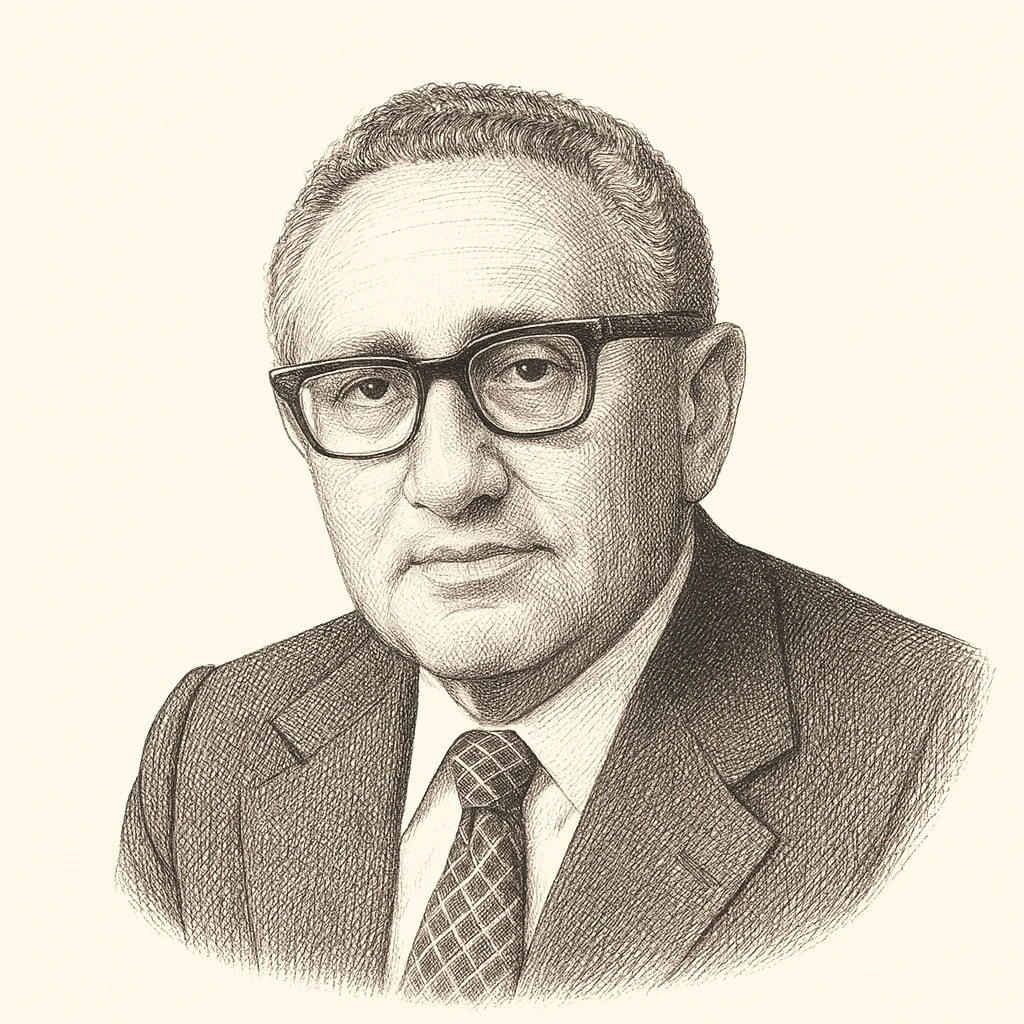
Henry Kissinger was the most influential American practitioner of realpolitik in the twentieth century, a scholar of European diplomacy who moved from Harvard into the highest reaches of government as National Security Advisor and Secretary of State under Presidents Nixon and Ford. His political thought was rooted in the tradition of balance-of-power statecraft associated with figures like Metternich and Castlereagh, whom he studied in his academic work. He held that international order rests not on moral aspiration but on a stable equilibrium among great powers, and that statesmen must manage this equilibrium through calculation, credibility, and a willingness to accept imperfect outcomes rather than pursue utopian ends.
In practice this meant pursuing détente with the Soviet Union, orchestrating the diplomatic opening to China, and treating the pursuit of national interest as prior to ideological consistency or humanitarian preference. Kissinger argued that stability was itself a supreme good, since the alternative in a nuclear age could be catastrophic, and that a great power's restraint had to be paired with the demonstrated capacity and resolve to use force. This gave his thinking a pragmatic, anti-ideological cast that appealed to those who distrust moralism in foreign affairs, and it shaped how generations of policymakers and academics understand deterrence, negotiation, and the architecture of international order.
His record is also deeply and legitimately contested. Critics hold him responsible for the conduct and consequences of policy in Southeast Asia, including the bombing of Cambodia, and for American involvement in and toleration of authoritarian actors in Chile, Argentina, East Timor, Bangladesh, and elsewhere. To these critics his realism was a rationalization for indifference to mass suffering and for actions they characterize as crimes; to his defenders it was sober stewardship in a dangerous world. Any honest account of Kissinger's thought must hold both the intellectual coherence of his realism and the human costs charged against the policies it justified.
Across decades of writing and consulting after leaving office, he remained a defining voice in debates over grand strategy, insisting that enduring order requires the patient reconciliation of power with a shared sense of legitimacy—an argument that continues to structure how the field of international relations frames the choices facing great powers.
Henry Kissinger is associated with Pragmatic Centrist. See the archetype