
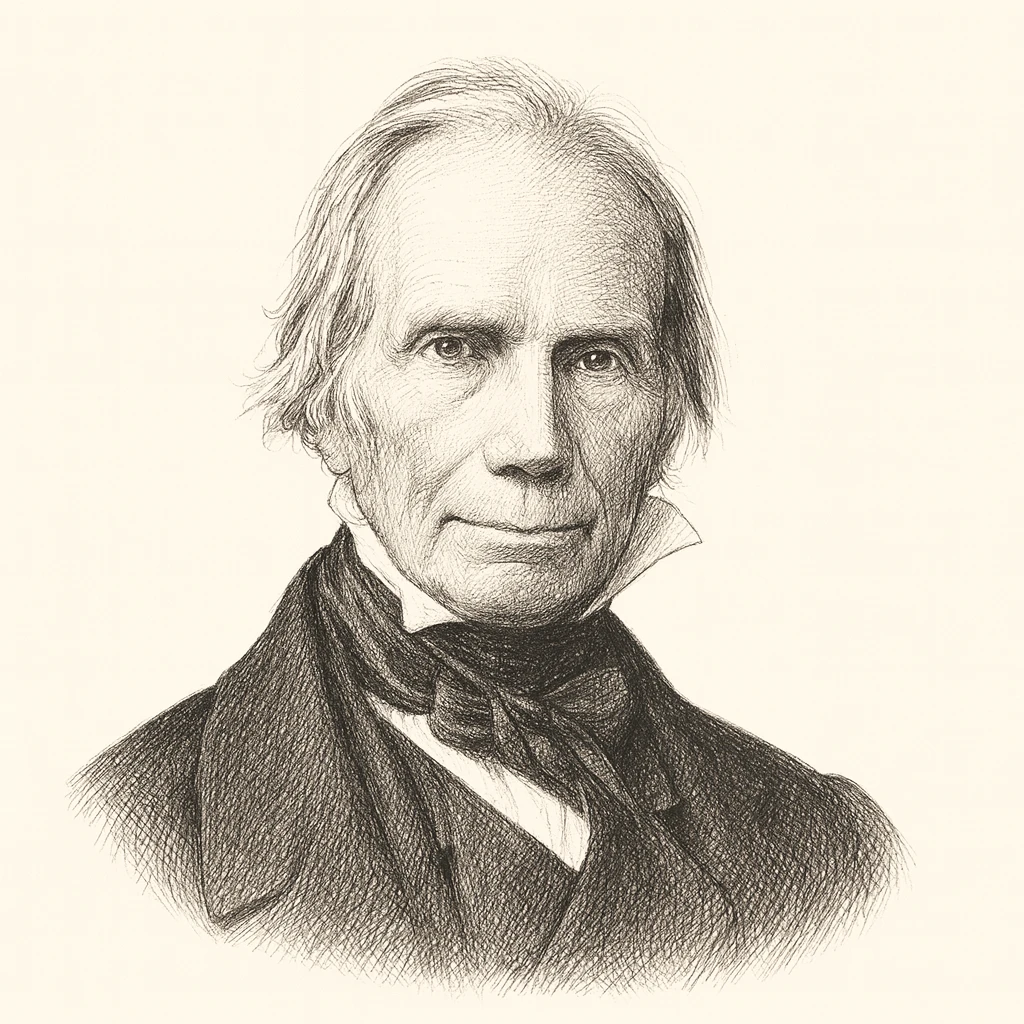
Henry Clay built his political thought around the conviction that a fragile republic held together by regional interests required active statecraft, negotiation, and a strong national economic framework. As a leading figure in the Whig tradition he championed what became known as the American System, a program pairing protective tariffs, a national bank, and federally supported internal improvements such as roads and canals. The animating idea was that these elements reinforced one another: tariff revenue and manufacturing would create a home market for agricultural goods, and improved transportation would knit distant regions into a single interdependent economy. This vision of energetic government fostering national development stood in deliberate contrast to the more agrarian, states-rights orientation of his Jacksonian rivals.
Clay is best remembered as the "Great Compromiser," a reputation earned through his central role in a series of legislative bargains meant to contain the escalating conflict over slavery and its extension into new territories. He was instrumental in the Missouri Compromise and, near the end of his life, in the arrangement of 1850, each an attempt to balance the demands of North and South and postpone disunion. His governing instinct treated the preservation of the Union as a paramount political good, one worth substantial concession and half-measures, and he framed compromise not as weakness but as the essential craft of holding a divided nation together.
That instinct carries genuine tension. Clay himself was a slaveholder, and the compromises he engineered secured the Union in part by protecting slavery's existing reach and returning fugitive people to bondage—settlements that critics then and since have judged as bargains struck over the rights and lives of the enslaved. He favored gradual emancipation and colonization schemes rather than abolition, positions that reflected the limits of his moderation.
Across repeated, unsuccessful bids for the presidency, Clay nonetheless left a durable mark on American political thinking: a tradition that prizes national cohesion, deal-making across factions, and the use of federal power to promote economic growth. Later politicians, including Abraham Lincoln, cited him as a formative influence, and his career remains a reference point in debates about whether compromise stabilizes democracy or merely defers its reckonings.
Henry Clay is associated with Pragmatic Centrist. See the archetype