
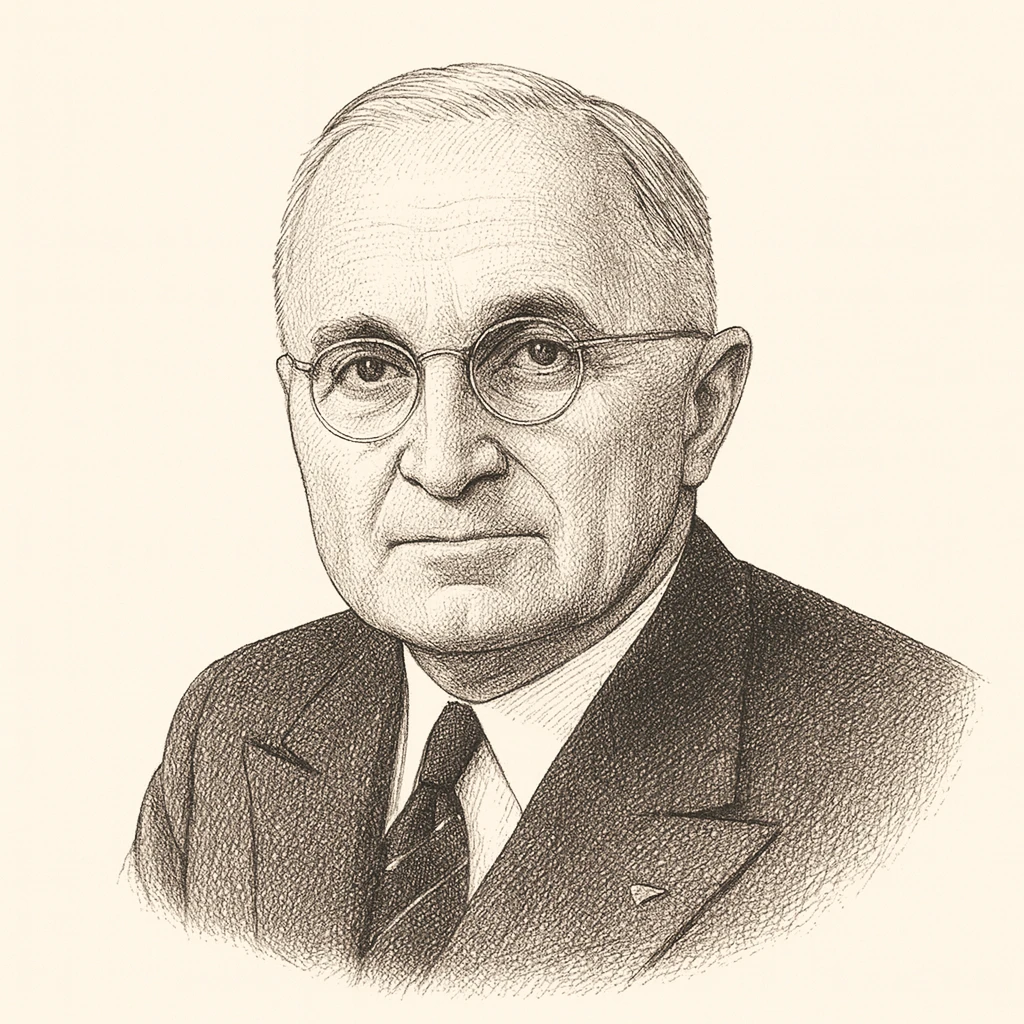
Harry S. Truman was the 33rd President, a Missouri haberdasher who inherited the presidency upon FDR's death and made decisions that shaped the postwar world: the atomic bomb, NATO, the Berlin Airlift, the Marshall Plan, and the Korean War. 'The Buck Stops Here' defined his plain-spoken accountability.
He authorized atomic bombs on Hiroshima and Nagasaki to end World War II, still the only use of nuclear weapons in war. Historians have disputed whether Japan would have surrendered without them; Gar Alperovitz argued in Atomic Diplomacy (1965) that Japan was already close to surrender. He articulated the Truman Doctrine, pledging American support to peoples resisting subjugation, which made containment of communism a global and open-ended commitment. He created NATO, binding the United States to the defense of Western Europe in the first peacetime military alliance it had entered outside the Western Hemisphere, and marshaled European recovery through the Marshall Plan, on the premise that economic recovery would reduce communism's appeal. When North Korea invaded the South, Truman intervened without a congressional declaration of war, an assertion of executive war powers that later presidents relied on in committing forces abroad.
Domestically, Truman's Fair Deal proposed expanding the New Deal with national health insurance, civil rights protections, and broader social provision, but faced congressional opposition from a coalition of Republicans and conservative Southern Democrats, and much of it stalled. His executive order desegregating the military (1948) was a major step in civil rights, issued despite the risk of alienating the South.
He left office unpopular; his standing rose in later decades, and surveys of historians, among them C-SPAN's, have since placed him among the ten highest-ranked presidents. He represents an older Democratic Party (working-class, patriotic, anticommunist, and socially moderate) whose Cold War liberalism paired an activist state at home with firm resistance to Soviet power abroad.
Harry Truman is associated with Conservative Democrat. See the archetype