
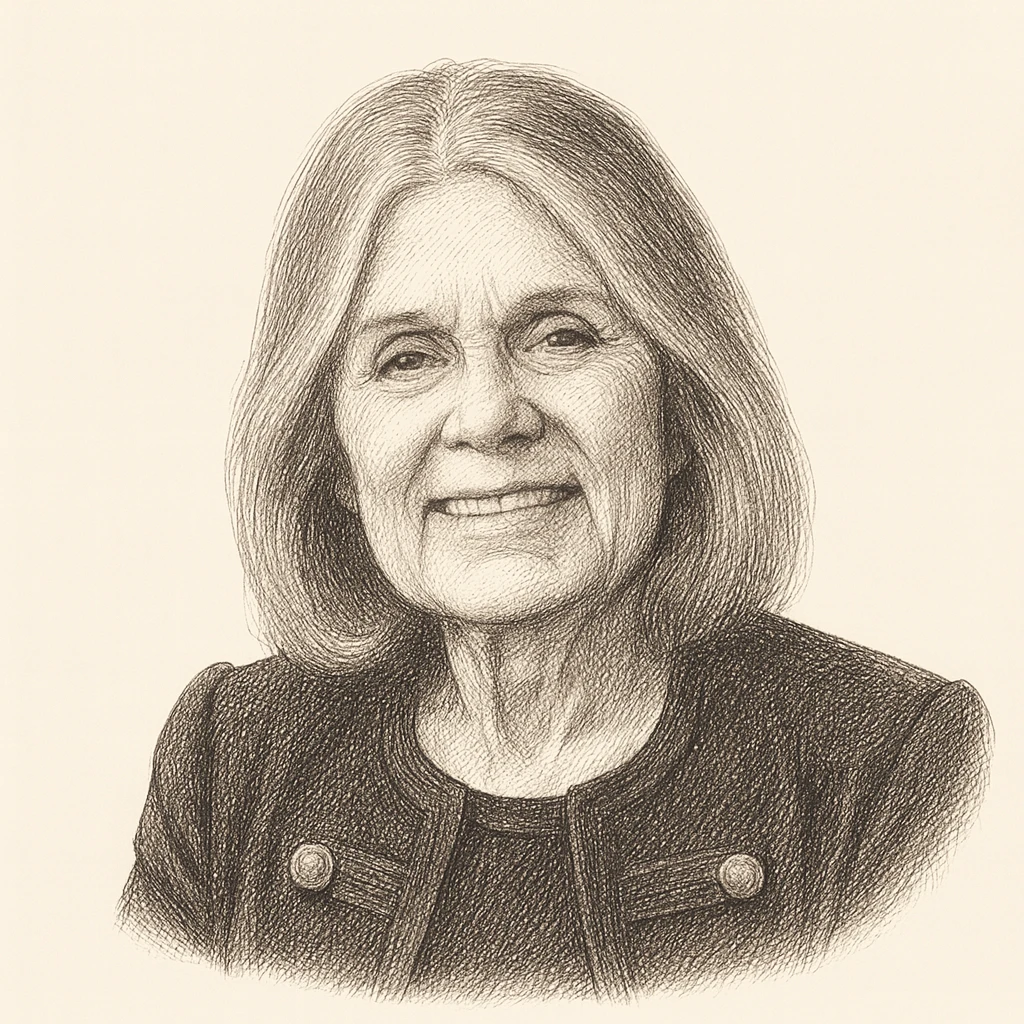
Gloria Steinem emerged in the late 1960s and 1970s as one of the most visible spokespeople for American second-wave feminism, translating movement arguments into language that reached a wide public. Trained as a journalist, she gained prominence through reporting and essays that framed the personal circumstances of women's lives—work, sexuality, reproduction, domestic labor—as fundamentally political questions rather than private matters. Her co-founding of Ms. magazine in the early 1970s gave the movement a durable platform that treated feminism as a serious field of ideas and reporting, not a passing controversy, and helped popularize an analysis in which sexism operates as a structural system rather than a set of individual attitudes.
Steinem's political thought sits within liberal and reformist strands of feminism, emphasizing equal rights, bodily autonomy, and the dismantling of legally and culturally enforced gender roles. She was a prominent advocate for reproductive rights and for the Equal Rights Amendment, and she helped build organizations and coalitions intended to translate feminist ideas into electoral and legislative influence. Over time she increasingly stressed that gender oppression intersects with race and class, aligning herself with efforts to link feminism to broader struggles for social justice, though an objection raised both within the movement and outside it held that mainstream second-wave feminism, including figures at its center, often centered the experiences of white, middle-class women.
As a public intellectual, Steinem's influence lies less in a single systematic theory than in her role as a synthesizer and communicator who made feminist claims legible to a mass audience. She modeled a form of movement activism that combined journalism, organization-building, and sustained public presence across decades, and she became a symbol around which supporters rallied and opponents organized. Her career illustrates both the reach and the limits of a media-centered activism: it broadened public acceptance of women's equality as a legitimate political goal while drawing debate over who speaks for a movement and whose priorities such visibility elevates. She died at her home in New York City on September 2, 2026, at 92.
Gloria Steinem is associated with Progressive Activist. See the archetype