
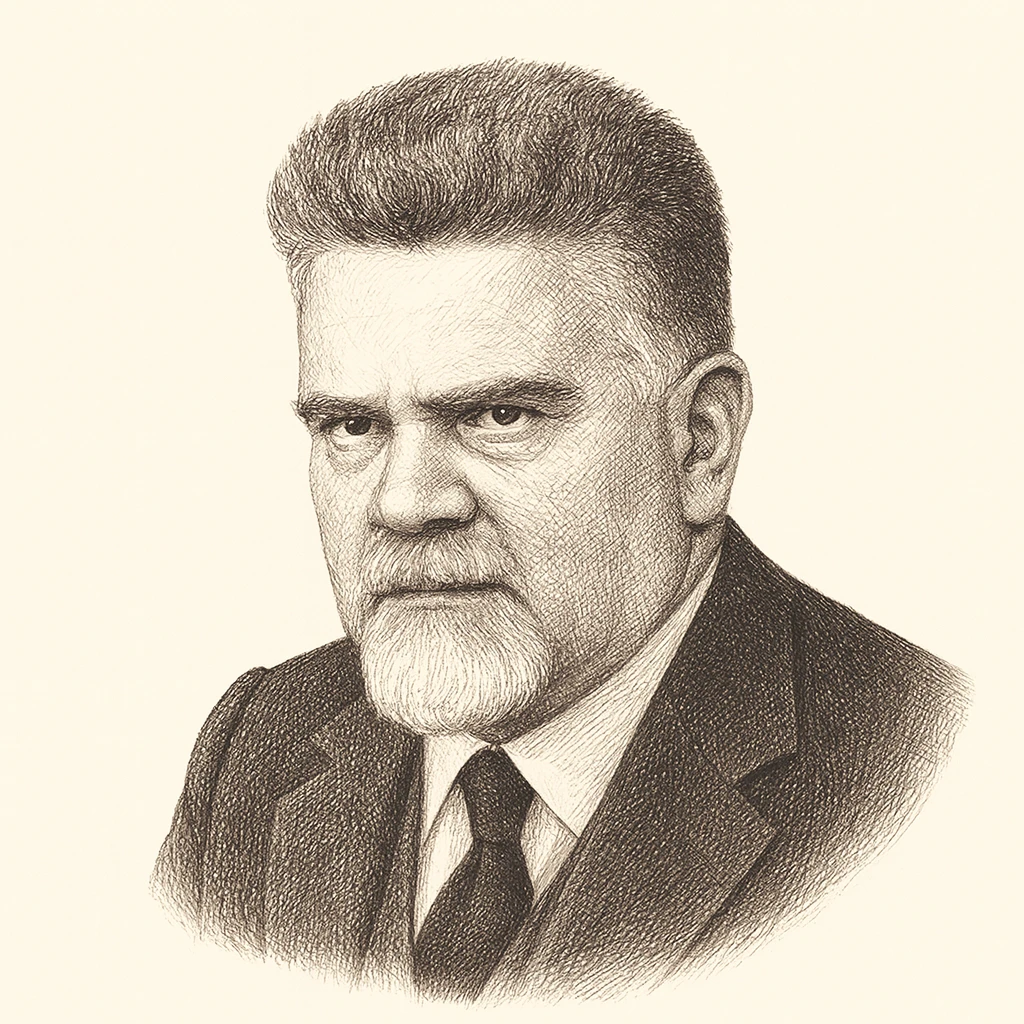
Giovanni Gentile (1875–1944) was an Italian philosopher who became the leading theorist of Fascism and one of the most influential figures in early twentieth-century Italian idealism. Trained in the tradition of Hegelian thought, he developed a philosophy he called "actual idealism" (attualismo), which held that reality is constituted through the pure act of thinking. Alongside Benedetto Croce, with whom he later broke, he was a central voice in the revival of idealist philosophy in Italy, and he applied its concepts of spirit, unity, and self-realization to questions of ethics, education, and the state.
Gentile's political thought centered on a conception of the state as an ethical and spiritual totality rather than merely a legal or administrative institution. He rejected the liberal and individualist premise that the individual precedes the state, arguing instead that persons realize their true freedom and moral identity only through participation in a larger collective will embodied in the state. This organic and anti-liberal vision, in which the individual and the community were understood as ultimately identical, gave philosophical shape to the Fascist claim that the state should encompass the whole of national life. His formulations are often summarized in the idea of a "total" state that leaves nothing outside itself.
Gentile aligned himself with Benito Mussolini's regime and served as a minister of education, undertaking a major reform of the Italian school system that bore his name and reflected his belief in education as a spiritual and formative act. He is widely credited with contributing to the theoretical exposition of Fascist doctrine, lending the movement an intellectual respectability it otherwise lacked. He also played a role in cultural institutions and encyclopedic projects that shaped Italian intellectual life during the period.
His identification with Fascism remained firm even after the regime's collapse, when he associated himself with Mussolini's later republic in northern Italy; he was killed by anti-fascist partisans in 1944. Gentile's legacy is deeply contested: he is remembered both as a serious and rigorous philosopher within the idealist tradition and as the thinker who gave Fascism its most coherent philosophical justification. For students of political thought, he remains a key example of how idealist metaphysics could be marshaled to legitimize a totalitarian conception of the state and to challenge liberal individualism.
Giovanni Gentile is associated with Reactionary Strongman. See the archetype