
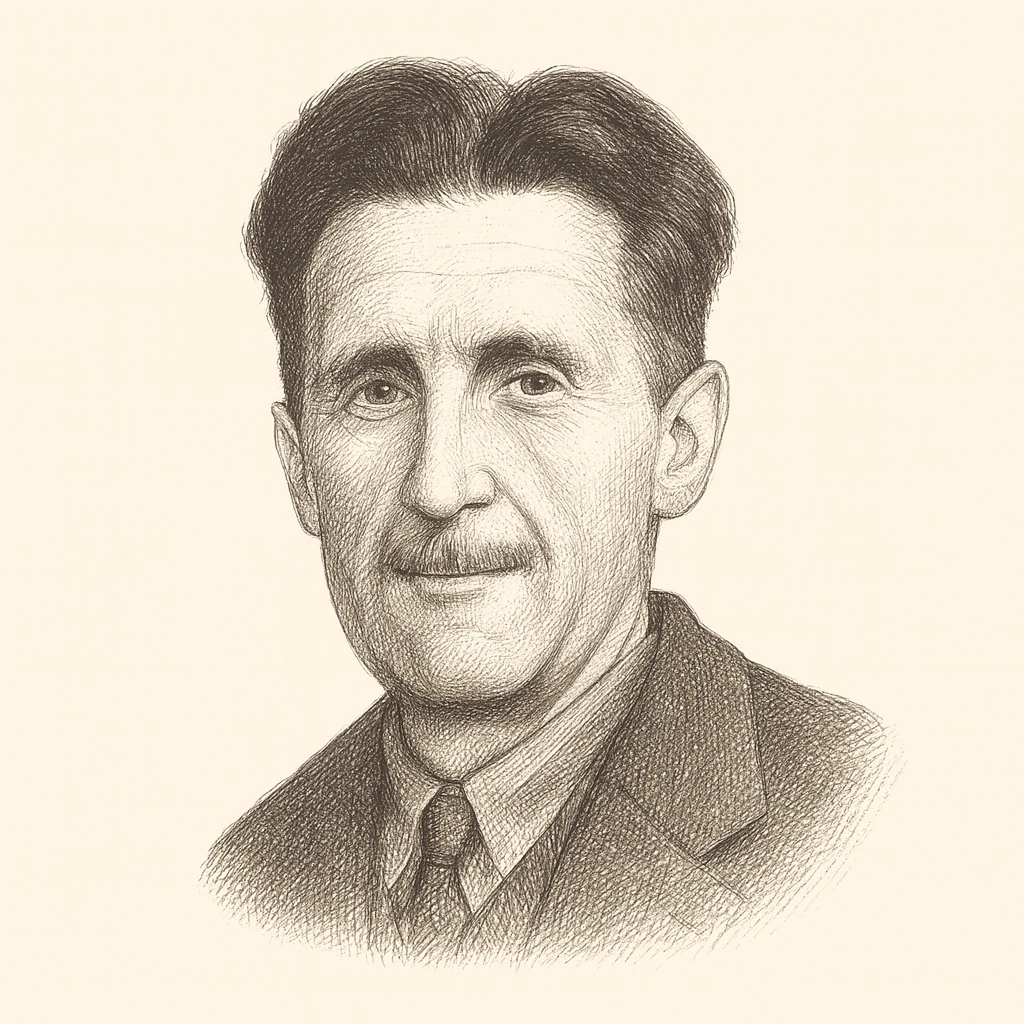
Eric Arthur Blair — George Orwell — was born in 1903 in Motihari, Bengal, where his father was a minor official in the Opium Department of the Indian Civil Service. The family returned to England when he was four, and he grew up in Henley-on-Thames in the lower reaches of the upper-middle class — the class he would later analyze with surgical precision in The Road to Wigan Pier, the class that kept up appearances on incomes barely sufficient to maintain them, sending its sons to expensive schools while eating margarine in secret at home. He won a scholarship to Eton and spent five years there absorbing the class consciousness of English education — the minute gradations of accent, dress, and social confidence that organized English social life — and developing the independent habits of thought that made him unsuitable for the career his schooling was supposed to prepare him for.
He did not go to Oxford or Cambridge. Instead, at eighteen, he joined the Indian Imperial Police in Burma, where he served for five years as a colonial officer — making the system of imperial domination work, arresting people, witnessing corporal punishment, presiding over a hanging. The experience was formative and remained with him. His essay "A Hanging" (1931) and his novel Burmese Days (1934) were his attempts to reckon with it: the specific moral texture of being part of a system that was unjust and that you could not simply resign from without consequences, the way that complicity worked itself into the grain of daily life. He resigned from the Imperial Police in 1927, returned to England, and decided to become a writer.
The next several years were the period of voluntary poverty that produced Down and Out in Paris and London (1933): working as a dishwasher in Paris restaurant kitchens, tramping around England, sleeping in doss-houses, picking hops in Kent. He was investigating poverty from the inside with the methodical curiosity of a natural scientist, and the book that resulted was the first demonstration of his literary gift — the ability to describe working-class life to middle-class readers without condescension, without romanticization, and without losing the specific textures of actual experience in abstraction. The Road to Wigan Pier (1937) applied the same method to industrial working-class life in the North of England, with the addition of a second section that was a scathing attack on the British left's class condescension — its inability to deal honestly with working-class culture, its theoretical socialism combined with personal fastidiousness about the actual people whose interests it claimed to represent.
Spain changed everything. He went in December 1936 to fight for the Republic against Franco, joined the POUM militia (a dissident Marxist organization unaffiliated with the Communist Party), was shot through the throat by a fascist sniper near Huesca and nearly killed, and came back convinced that the Communists who nominally shared his cause were willing to lie, torture, and murder to maintain their ideological purity. What he witnessed — the suppression of the POUM by Communist forces, the show trials of POUM leaders, the systematic falsification in the Communist press of what was actually happening on the ground — gave him a visceral understanding of how totalitarianism worked: not primarily through violence but through the control of language, the alteration of the historical record, and the manufactured consensus about what was permitted to be true. Homage to Catalonia (1938), his account of the experience, was received with hostility by the British left press, which did not want to hear what he had to say.
The war years brought him back to England, where he worked in the Home Guard and then at the BBC, writing propaganda for the Indian section — work that he found demoralizing but that deepened his understanding, from the inside, of how propaganda functioned and what it did to the people who produced it. His wartime essays — "The Lion and the Unicorn" (1941), with its complicated patriotism; "Looking Back on the Spanish War" (1943); the ongoing journalism for Tribune — established him as the most distinctive political voice of the British left: someone who held firm socialist commitments while maintaining complete intellectual independence from the organizations that claimed to represent them.
Animal Farm (1945) was rejected by four publishers, including his regular publisher Victor Gollancz, who declined on the grounds that it was too anti-Soviet — in 1944, when the Soviet Union was Britain's ally. Jonathan Cape initially accepted it and then withdrew under pressure from the Ministry of Information. Secker and Warburg finally published it, and its extraordinary success transformed Orwell from a respected but marginal figure into an international presence. Nineteen Eighty-Four followed in 1949, written against his own rapidly deteriorating health in a farmhouse on the Scottish island of Jura that he had rented precisely because its remoteness would force him to concentrate, finished while he was coughing up blood, published six months before his death from tuberculosis at forty-six.
What made Orwell irreplaceable was not primarily his fiction but his essays. "Politics and the English Language" (1946), "Shooting an Elephant" (1936), "Such, Such Were the Joys" (1952), "Why I Write" (1946) — these established a standard for political prose that mixed clarity, honesty, and controlled anger in proportions almost no one since has matched. He had a quality rarer than intelligence: he was difficult to corrupt, and he made that difficulty seem like the normal condition of a decent person rather than the achievement of an exceptional one.
George Orwell is associated with Trad Socialist. See the archetype