
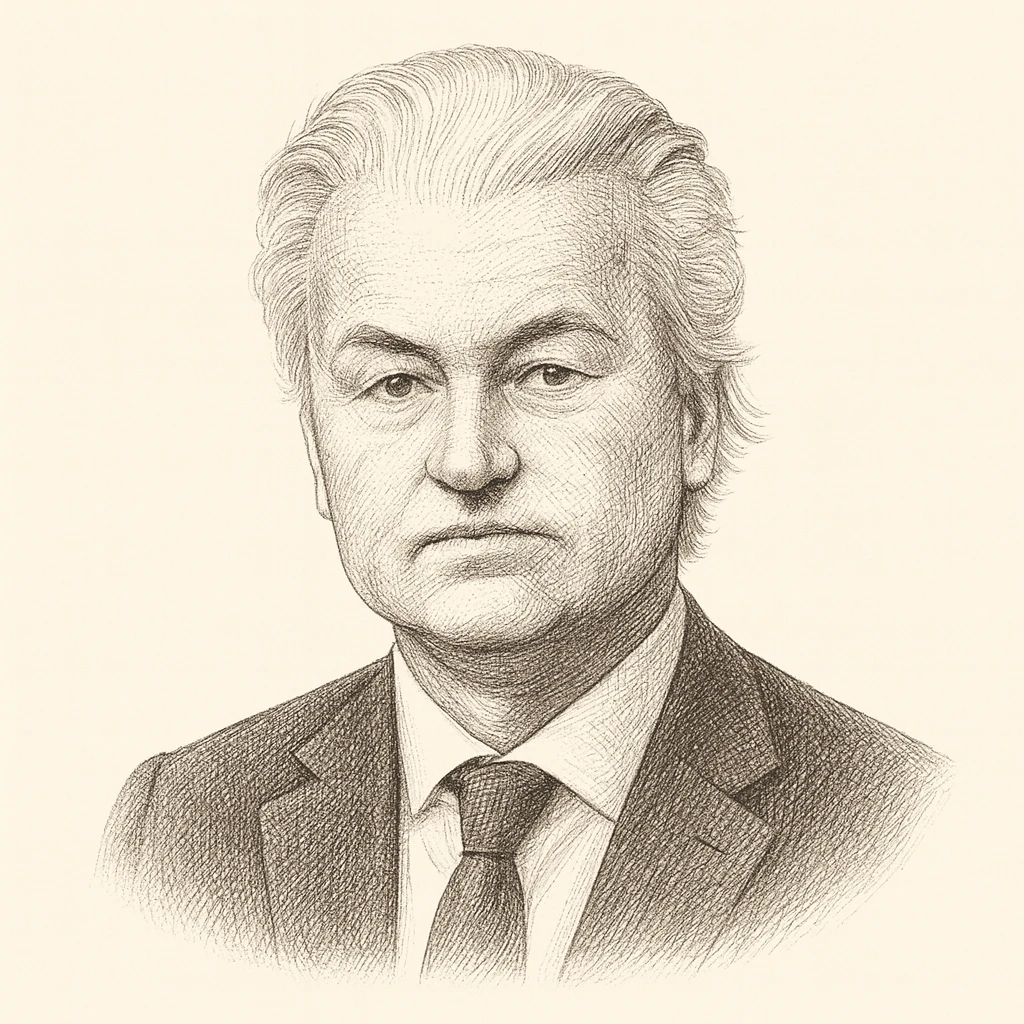
Geert Wilders is a Dutch politician who founded and leads the Party for Freedom (Partij voor de Vrijheid, PVV), which he established in the mid-2000s after breaking with the mainstream liberal VVD. His political thought fuses a strong civilizational nationalism with elements of classical liberalism: he defends what he frames as Western, secular, and Enlightenment values while arguing that these are under threat from mass immigration and, above all, from Islam. Wilders characterizes Islam not merely as a religion but as an ideology incompatible with liberal democracy, and he has built his platform around restricting immigration, limiting Islamic institutions and practices, and reasserting national sovereignty against supranational bodies, particularly the European Union.
His thinking sits within the broader tradition of European right-wing populism, which pits an ordinary native people against both an immigrant "other" and a cosmopolitan political and cultural elite accused of ignoring popular concerns. Wilders combines this populist framing with a notably assertive defense of free speech, gay rights, women's equality, and Israel—positions he presents as markers of Western civilization that he claims Islam endangers. This blend distinguishes his rhetoric from older ethnic or religiously conservative nationalisms and has made him an influential model for a securitized, culturally liberal-inflected form of anti-immigration politics.
Wilders's career has become a test case in debates over the limits of political speech and the boundary between criticism of religion and incitement against a group. He has faced prosecution in the Netherlands over statements concerning Muslims and Moroccans, cases that themselves became arguments in his broader narrative about elite suppression of dissent. Living for years under sustained security protection because of threats against him, he has also become a symbol in wider Western arguments about religion, terrorism, and freedom of expression.
His influence lies less in systematic theory than in agenda-setting: he helped normalize the framing of immigration and Islam as central civilizational questions in Dutch and European politics, pressuring mainstream parties to harden their positions. The PVV's electoral strength, including a major result that made it the largest party in a Dutch general election, demonstrated the durability of his appeal and reinforced his standing as a reference point for nationalist and populist movements across Europe.
Geert Wilders is associated with Welfare Nationalist. See the archetype