
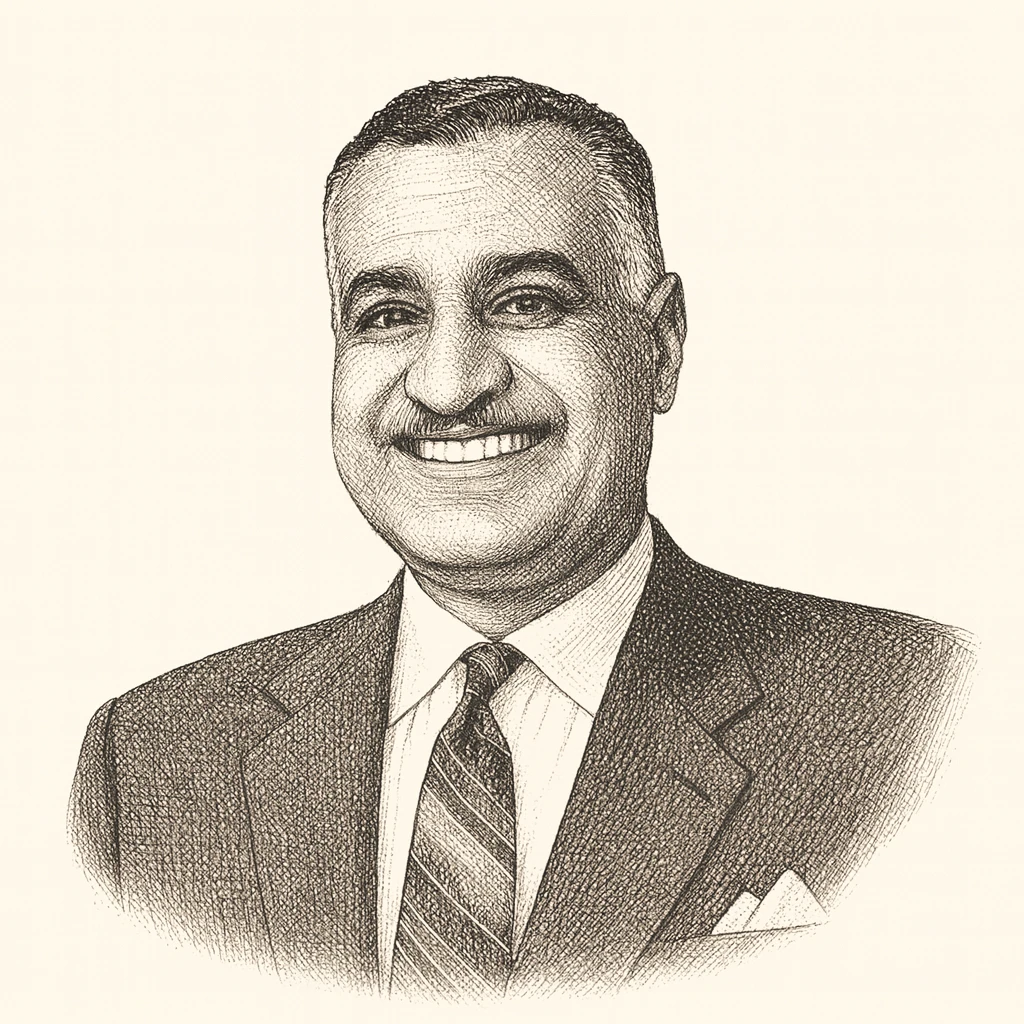
Gamal Abdel Nasser rose from the 1952 Free Officers' movement that overthrew Egypt's monarchy to become the defining political figure of the postcolonial Arab world. His thought, later labeled Nasserism, wove together several strands: secular pan-Arab nationalism, opposition to Western imperialism and its regional clients, and a state-directed model of economic development often described as "Arab socialism." He argued that genuine political independence required economic independence, and that the fragmented Arab states could recover dignity and strength only through unity and self-reliance rather than alignment with either Cold War bloc.
Nasser's ideas took concrete form in signature acts that resonated far beyond Egypt. The 1956 nationalization of the Suez Canal Company, and Egypt's political survival of the ensuing British, French, and Israeli invasion, made him a symbol of successful anti-colonial defiance. Alongside leaders such as Tito, Nehru, and Sukarno, he became a leading voice of non-alignment, positioning the newly independent nations as an independent force in world affairs. Domestically, he pursued land reform, nationalization of major industries, and public investment in education and infrastructure, framing the state as the engine of social justice and modernization.
His pan-Arabism was aspirational and often outran political reality: the union of Egypt and Syria in the United Arab Republic collapsed after a few years, and the crushing Arab defeat in the 1967 war with Israel badly damaged both his prestige and the credibility of his project. These episodes exposed the gap between the mobilizing power of his rhetoric and the institutional weakness of the movements built around it.
Nasser's record is seriously contested. His government was a single-party authoritarian state that suppressed political opposition, jailed and tortured dissidents—including Muslim Brotherhood members and communists—censored the press, and concentrated power in a security apparatus and a cult of personality. Admirers credit him with restoring Arab self-respect, advancing land reform, and giving voice to anti-imperial aspiration; critics point to repression, military adventurism, and the fragility of the personalist system he left behind. His enduring influence lies in fusing nationalism, anti-colonialism, and state-led redistribution into a political idiom that shaped Arab politics for generations, even as later leaders invoked his name to legitimize very different regimes.
Gamal Abdel Nasser is associated with Left Nationalist. See the archetype