
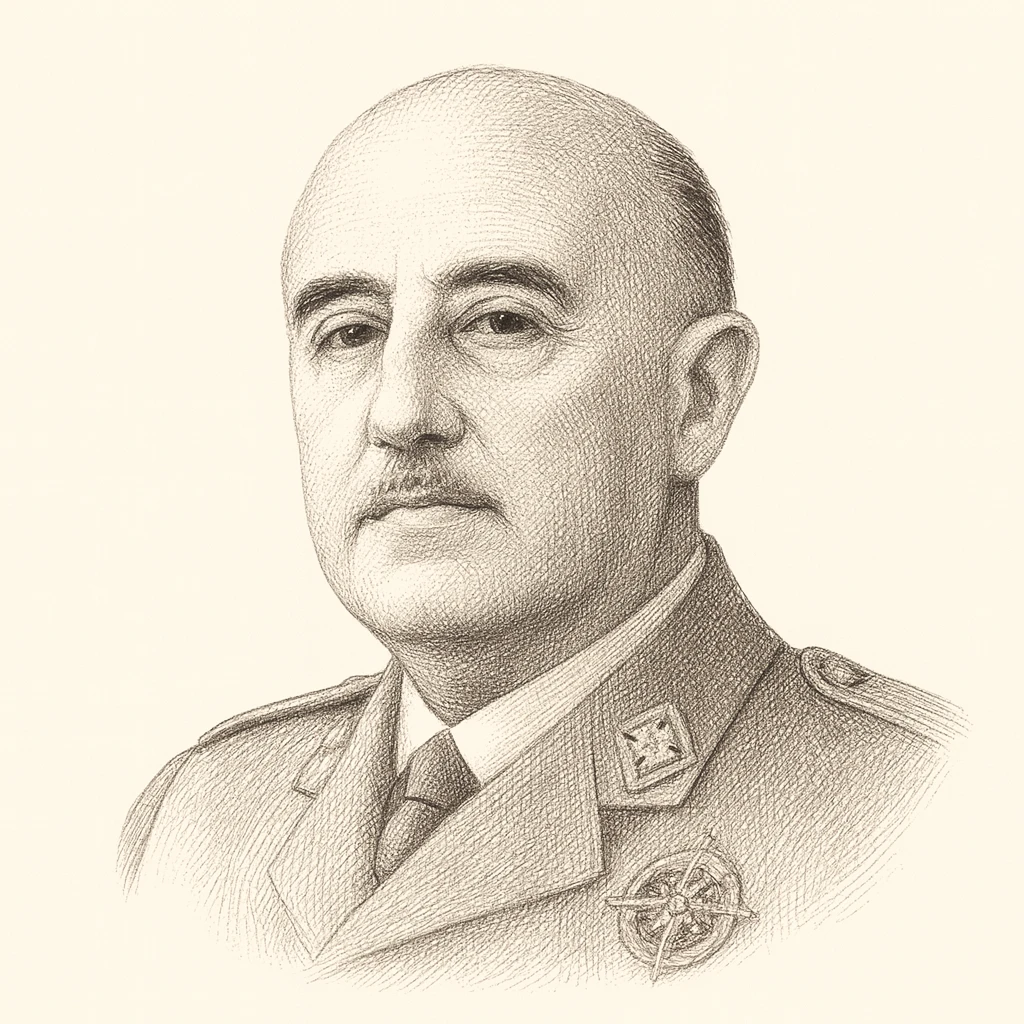
Francisco Franco was the Spanish general who led the Nationalist forces to victory in the Spanish Civil War (1936-39) and ruled Spain as dictator until his death in 1975. Rising through the military in Morocco, Franco initially hesitated to join the 1936 uprising but soon became its leader, aided by Nazi Germany and Fascist Italy. The Civil War killed hundreds of thousands and became a rehearsal for World War II.
Franco's political thought rested less on a coherent doctrine than on a fusion of existing traditions of the Spanish right. His regime's ideology combined Catholic traditionalism, Spanish nationalism, and anti-communism, drawing on the corporatist and monarchist currents of the right and on the Falange, the fascist party whose rhetoric and symbols the regime absorbed and subordinated to Franco's personal authority. National Catholicism, the identification of Spanish national identity with the Catholic Church, gave the regime a spiritual justification, casting the Civil War as a crusade. Franco presented himself as the guarantor of a unified, hierarchical, and Catholic Spain against the disorder he attributed to the Second Republic.
Franco's victory led to decades of authoritarian rule—political prisoners, censorship, suppression of regional languages and identities, particularly Catalan and Basque, which the regime viewed as threats to national unity. Power was concentrated in Franco himself as Caudillo, and the state suppressed independent parties, free trade unions, and dissent while enforcing conservative Catholic social norms. The repression of defeated Republicans continued for years after the war ended, with tens of thousands executed.
Franco kept Spain out of World War II despite German pressure, then survived into the Cold War by offering bases to the United States, which sought anti-communist allies and gradually ended his regime's international isolation. The regime gradually liberalized economically, especially from the late 1950s, when technocrats often linked to Opus Dei promoted market-oriented policies and foreign investment that produced rapid growth, while the state remained politically repressive.
Franco appointed Juan Carlos as his successor, expecting continued authoritarianism; instead, the king shepherded Spain's transition to democracy after Franco's death in 1975. Democratic Spain later legislated on the regime's record through the Historical Memory Law of 2007 and the Democratic Memory Law of 2022, and in 2019 Franco's remains were exhumed from the Valley of the Fallen and reburied in a family plot.
Francisco Franco is associated with Reactionary Strongman. See the archetype