
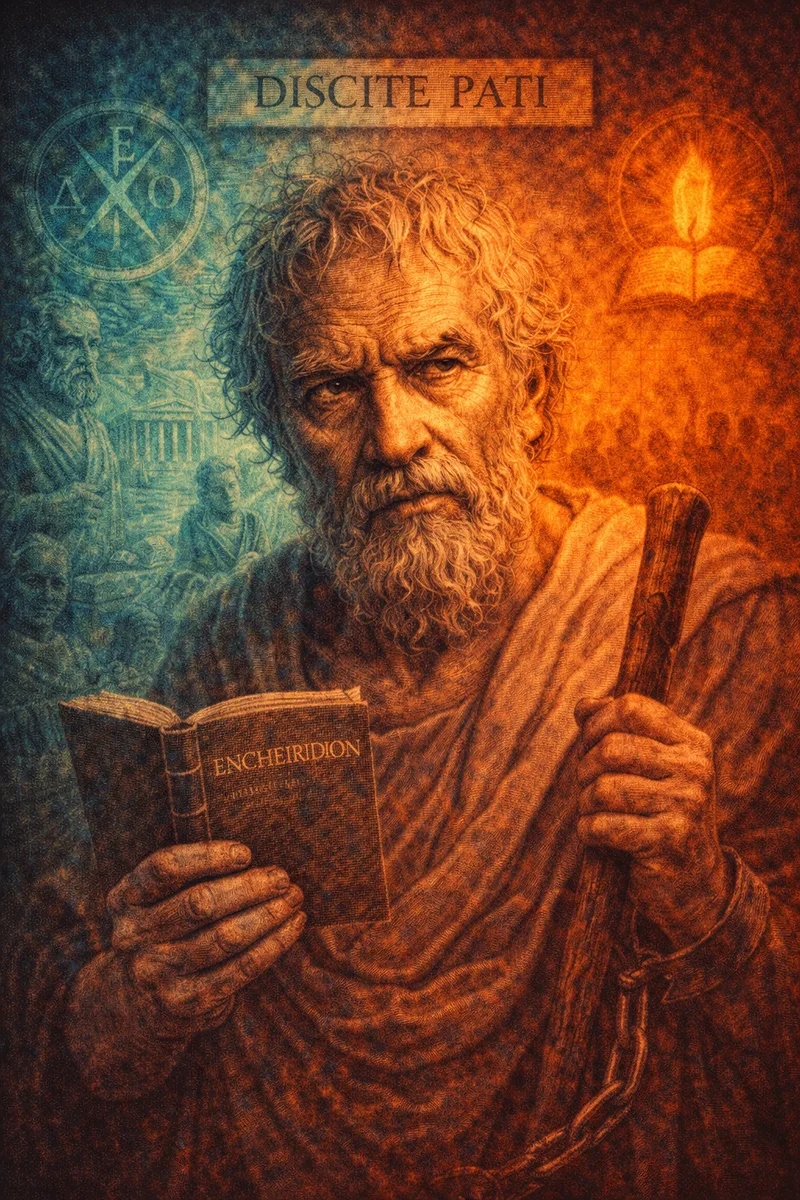
Epictetus was a Stoic philosopher who rose from slavery to become one of antiquity's most influential teachers of ethics. Born a slave in Hierapolis (modern Turkey), Epictetus was brought to Rome where his owner allowed him to study philosophy. Freed eventually, he taught in Rome until Emperor Domitian expelled philosophers, after which he established a school in Greece.
Epictetus taught that the key to freedom and happiness is distinguishing what is 'up to us' (our judgments, impulses, and desires) from what is not (health, wealth, reputation, and external circumstances). We suffer not from events but from our judgments about them. The Enchiridion (Handbook) summarizes his practical wisdom.
This teaching had political implications. If liberty resides in the faculty of choice (prohairesis) rather than in one's legal or social station, then no external power, not even a master or an emperor, can enslave a person who governs their own judgments. Epictetus, who had himself been property, told a slave-owner that his slave was his brother, descended like him from Zeus, so that legal status marked no difference in moral worth. Yet his stress on inner freedom also counseled acceptance: the Handbook tells its reader to wish that things happen as they do, and to play well the part assigned, like an actor in a drama whose author chooses the role.
This egalitarianism drew on Stoic cosmopolitanism: the view that all human beings are rational fragments of a single divine order and thus fellow citizens of one world community, bound by duties that follow from our relationships and social roles. Epictetus grounded ethics in fulfilling these obligations while holding externals with detachment, framing the person as a participant in a rationally ordered whole.
Epictetus's philosophy was recorded by his student Arrian, like Socrates' by Plato. His influence extends through Marcus Aurelius (who came to know his discourses through his teacher Rusticus and quoted him in the Meditations), Christian monasticism, where the Handbook was used in Christianized form, modern cognitive behavioral therapy, whose founders acknowledged his claim that distress springs from beliefs rather than events, and Stoicism's contemporary revival. As a former slave teaching that true freedom is internal, Epictetus embodies Stoic philosophy's radical egalitarianism.
Wondering where you land? Take the 4-minute assessment