
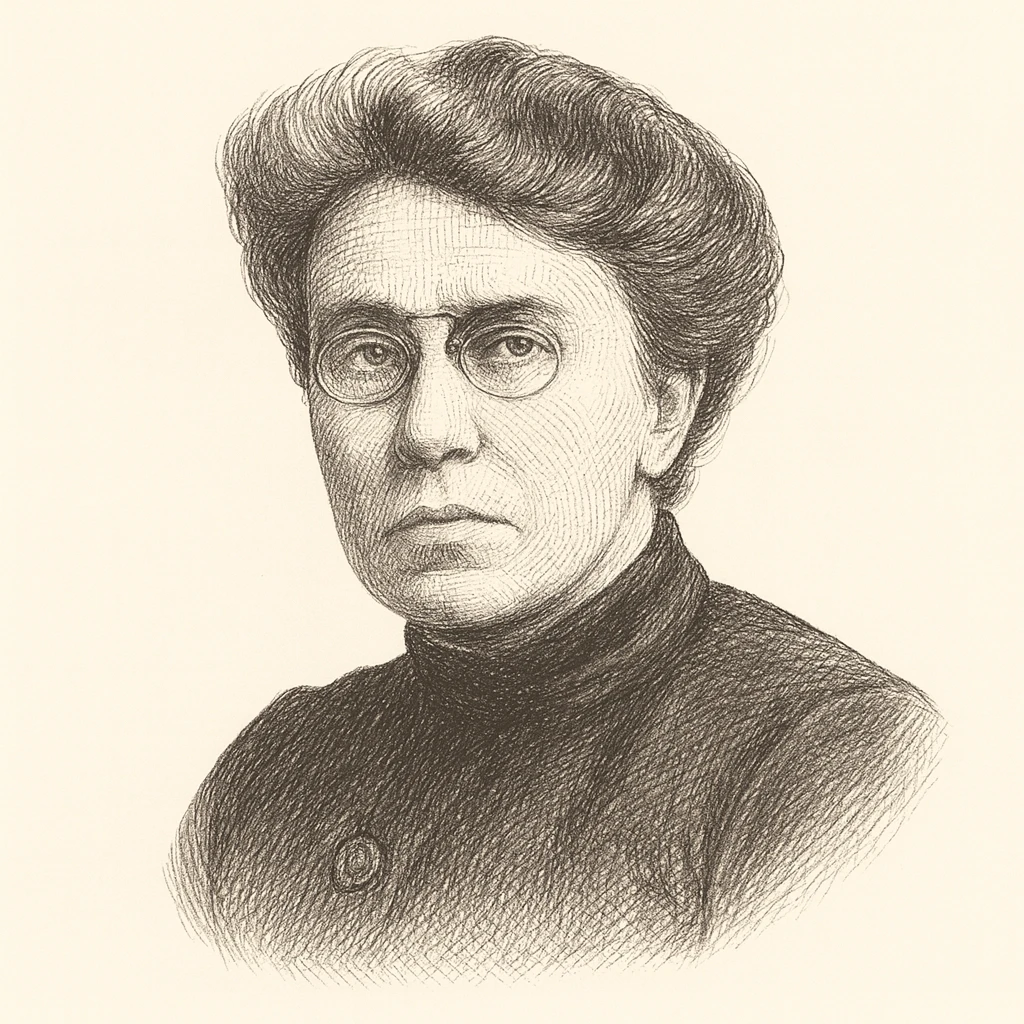
Emma Goldman was the most charismatic radical political figure in early 20th century America, a tireless anarchist organizer, lecturer, editor, and activist whose willingness to be arrested repeatedly for her political work turned her into a nationally recognized symbol of radical dissent. She was deported from the United States in 1919 during the first Red Scare, spent the rest of her life in exile, and has since been recovered as one of the foundational figures of anarchist feminism and of the broader radical tradition in American political thought. Her writings on political philosophy, sexual freedom, anti-militarism, and the foundations of individual liberty remain original contributions to the anarchist and libertarian traditions.
Goldman was born in 1869 in what is now Lithuania, then part of the Russian Empire, into a poor Jewish family that moved repeatedly in search of better conditions. She grew up in the shadow of Russian antisemitism and state violence, emigrated to the United States with her older sister in 1885 at sixteen, and went to work in a corset factory in Rochester, New York. Her political awakening came from the Haymarket affair of 1886 — the Chicago labor protest that ended in a bombing and the subsequent execution of four anarchist labor organizers on what was almost certainly falsified evidence. For Goldman, who was then seventeen, the Haymarket executions revealed that the United States was not the free country she had been promised but a state that would execute radicals who threatened capitalist power. She committed herself to anarchism and spent the rest of her life making that commitment real.
By her early twenties, Goldman had moved to New York City and become part of the anarchist immigrant community of the Lower East Side. She met Alexander Berkman, who became her longtime political partner and lifelong friend, and together they developed an anarchist politics that drew on European sources (Kropotkin, Bakunin, Stirner) but adapted them to American conditions. In 1892, Berkman attempted to assassinate the industrialist Henry Clay Frick in response to Frick's violent suppression of the Homestead steel strike, in which several workers had been killed. The assassination attempt failed, Berkman was sent to prison for fourteen years, and Goldman was nearly lynched by the press and public for her known association with him. The experience taught her that propaganda of the deed — political violence as a way of awakening the working class — was both morally and strategically mistaken, and she spent the rest of her career advocating for anarchism through speech, writing, and organizing rather than through violence.
What made Goldman distinctive among anarchists was her unflinching insistence that personal life was inseparable from political life. She argued for sexual freedom, birth control, and the right of women to control their own bodies at a time when all of these were either illegal or politically marginalized. She helped distribute information about contraception when doing so was a federal crime. She publicly defended homosexuality and criticized the medicalization of gay and lesbian identities decades before gay liberation became a political movement. She attacked the institution of marriage as economically and sexually coercive, though she also wrote with nuance about the difficulty of genuine intimate relationships in a society whose basic structures corrupted them. Her insistence that political freedom was meaningless without personal freedom was one of the most distinctive contributions of American anarchist feminism.
Goldman's political activities repeatedly brought her into conflict with the American state. She was arrested in 1893 for telling a hungry crowd that the unemployed had a right to take bread if they could not earn it. She was arrested in 1901 after the assassination of President McKinley by a lone anarchist named Leon Czolgosz — even though Goldman had never met Czolgosz and had no connection to the assassination, the association with anarchism was enough. She was arrested in 1916 for distributing information about birth control. She was arrested most consequentially in 1917 for organizing the No-Conscription League in opposition to American entry into World War I, and after serving two years in prison she was deported to Russia in 1919 along with 248 other radicals in the first large-scale political deportation in modern American history.
Her time in post-revolutionary Russia was a profound disillusionment. Goldman had initially hoped the Bolshevik revolution might represent the kind of social transformation she had spent her life working for. What she found instead was state terror, the suppression of opposition (including other revolutionary socialists), the crushing of workers' soviets that did not follow the party line, and the emerging totalitarian structure of what would become Stalinism. She left Russia in 1921 and spent the rest of her life as a principled anti-Bolshevik as well as an anarchist, publishing My Disillusionment in Russia (1923) and becoming one of the earliest left-wing voices warning about the direction the Soviet experiment was taking. She spent her final years in exile — France, England, Canada — writing, lecturing, and supporting the Spanish anarchist movement during the Spanish Civil War. She died in 1940 in Toronto at seventy.
Emma Goldman is associated with Progressive Activist. See the archetype