
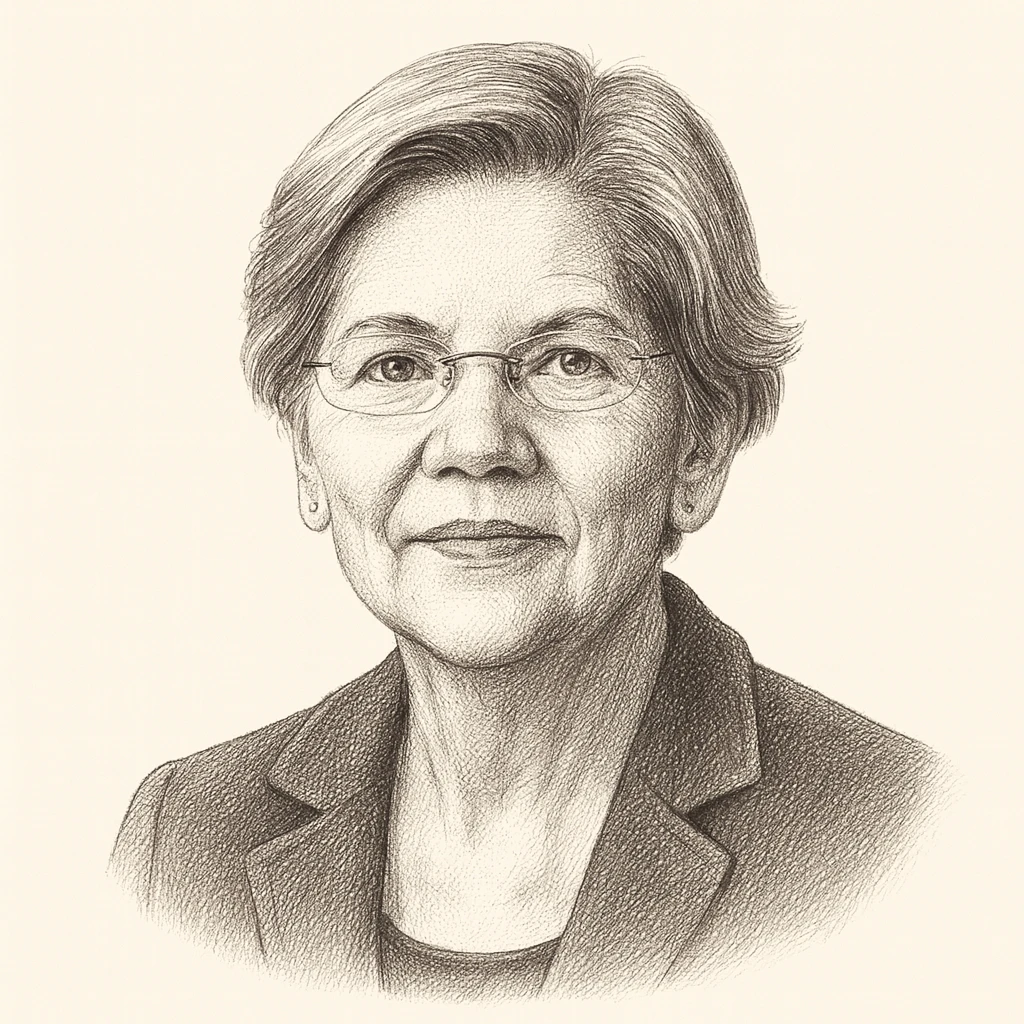
Elizabeth Warren developed her political outlook first as a legal academic specializing in bankruptcy and commercial law, where her empirical research on why American families fell into financial ruin led her to a broader critique of economic policy. She argued that middle-class insecurity was not primarily the result of personal irresponsibility but of structural forces: stagnant wages, rising fixed costs, predatory lending, and a financial system whose risks were increasingly shifted onto ordinary households. This research-driven, data-heavy approach became a hallmark of her later political persona, giving her progressive economic arguments an air of technocratic rigor rather than mere ideological assertion.
Warren's central political idea is that markets require rules to function fairly, and that government has a legitimate and necessary role in policing corporate and financial power. She gained national prominence advocating for stronger consumer financial protection in the wake of the 2008 financial crisis, and her ideas contributed to the creation of a federal consumer financial protection agency. Her rhetoric frequently frames the economy as "rigged" in favor of large corporations and the wealthy, and calls for structural reforms—stricter regulation, antitrust enforcement, and taxation of concentrated wealth—rather than incremental adjustment. In this she draws on an American progressive and trust-busting tradition while updating it for modern finance.
Elected to the U.S. Senate representing Massachusetts, and later a candidate for the Democratic presidential nomination, Warren became known for producing detailed, itemized policy proposals across areas such as financial regulation, corporate accountability, health care, and taxation. This emphasis on granular "plans" distinguished her within the Democratic Party and shaped debates about how far-reaching structural economic reform should go. She is often positioned on the party's progressive wing, though her framing tends to emphasize competitive, well-regulated capitalism rather than a rejection of markets as such.
Warren's influence lies in how she reintroduced questions of economic power and financial regulation into mainstream American political discourse, insisting that consumer protection and constraints on corporate influence are matters of democratic accountability. Her work helped popularize the argument that economic and political power are intertwined, and that reforming financial institutions is essential to preserving both middle-class stability and the integrity of democratic governance.
Elizabeth Warren is associated with Progressive Activist. See the archetype