
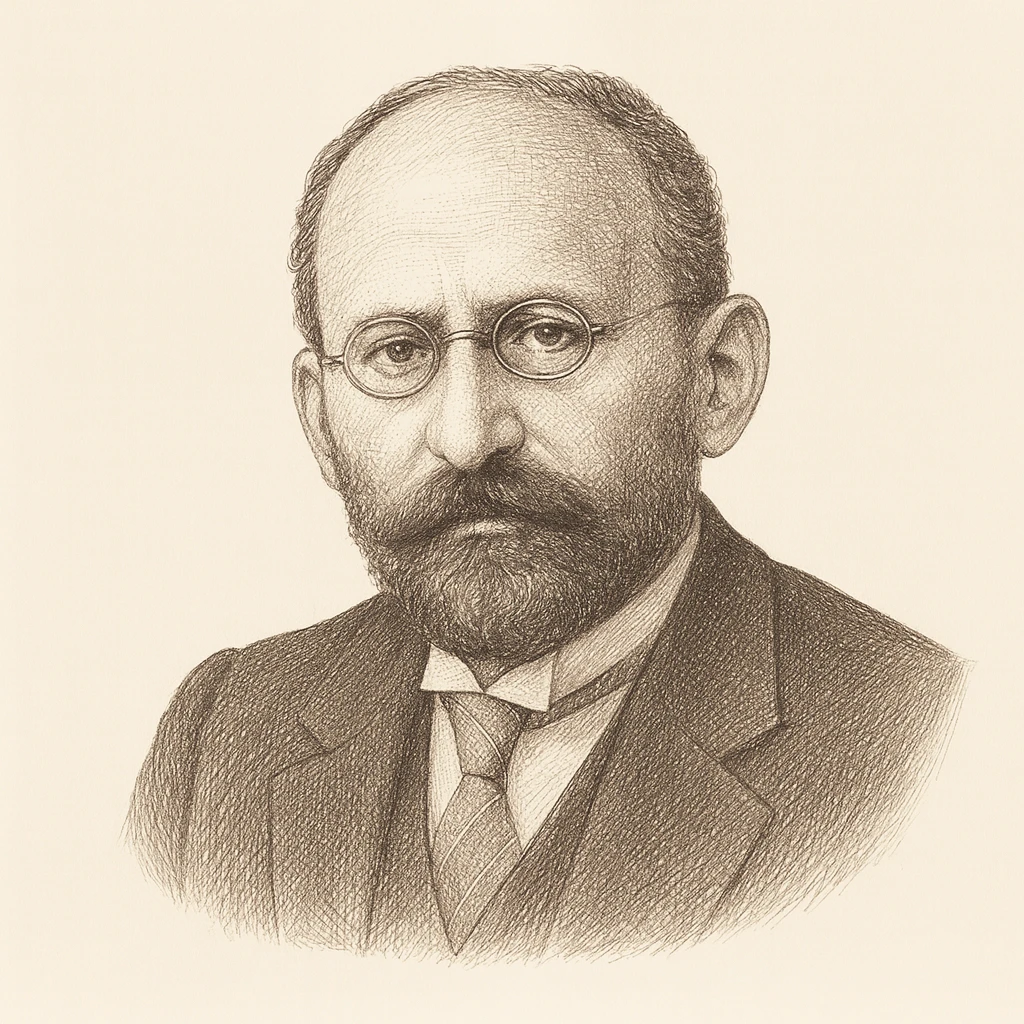
Eduard Bernstein was born in 1850 in Berlin, the son of a locomotive driver, and grew up in the artisan and working-class milieu of a city undergoing rapid industrialization. He left school at sixteen to become a bank clerk, educating himself in the evenings in the autodidactic tradition of the German working-class movement, and joined the Social Democratic Party in 1872. He was already a committed socialist when he was introduced to Marx's and Engels's theoretical framework, and the combination proved decisive: he became one of the most capable expositors of Marxist political economy in the German movement, trusted enough by Engels to be named one of his literary executors.
He went into exile in 1878 when Bismarck's Anti-Socialist Laws made open socialist activity in Germany illegal, living first in Zurich and then, from 1888, in London. The Zurich years were spent editing the SPD's newspaper Der Sozialdemokrat and conducting an extensive correspondence with Engels, who was then the principal theoretical authority of the international socialist movement. The London years were the ones that changed everything. He arrived as a committed revolutionary Marxist and encountered a very different kind of socialism in the circles of the Fabian Society — Sidney and Beatrice Webb, Bernard Shaw, Graham Wallas, and others who were building a socialist politics without revolutionary premises, through careful empirical study of social conditions, parliamentary agitation, and the patient accumulation of legislative reforms. He read their work, attended their meetings, and was forced to confront the possibility that they were asking better questions than the Marxist tradition he had been formed in.
The theoretical revision he undertook in London was grounded in empirical observation, not philosophical preference. He looked at the actual trajectory of European capitalism in the two decades since Marx's death and noted what had happened: the middle class had not contracted but grown; workers' living standards had risen rather than falling toward subsistence; capitalist crises had been managed rather than intensifying; the concentration of ownership was far less complete than Marx had predicted. The Marxist account of capitalism's inevitable collapse into its own contradictions was not being confirmed by the evidence. Bernstein's conclusion was not that socialism was impossible but that the theory that was supposed to make it inevitable was wrong — and that this mattered, because a socialist movement whose practical strategy depended on economic predictions that were not being confirmed was building on sand.
Evolutionary Socialism (1899) — the book in which he stated these conclusions — was one of the most controversial texts in the history of the European left. Its argument was simultaneously empirical and ethical: empirical in its critique of Marxist predictions, ethical in its insistence that the means of socialist politics could not be separated from its ends. A socialism achieved through democratic participation and legislative reform would be a different kind of socialism — answerable to the people it claimed to serve — from one achieved through revolutionary seizure of power by a vanguard that claimed to represent them. The democratic socialist position, in Bernstein's formulation, was not a compromise of principle but its most honest expression.
The backlash was fierce and immediate. Rosa Luxemburg's Reform or Revolution (1900) was the most powerful critique, arguing that Bernstein's empirical observations were compatible with a revolutionary strategy if you understood capitalism's contradictions properly. Karl Kautsky, the leading Marxist theorist of the day, denounced him as a revisionist — using the word that would stick as a term of abuse for anyone who questioned revolutionary orthodoxy. August Bebel, the SPD's political leader, condemned him at party congress. Bernstein accepted all of this with remarkable equanimity, arguing simply that the evidence was on his side and that the socialist movement would eventually have to face it.
He was permitted to return to Germany in 1901 after the Anti-Socialist Laws were lifted, served as a member of the Reichstag from 1902 to 1928 with interruptions, and spent the subsequent decades watching the debate he had started work itself out in the practice of the European labor movement. The British Labour Party's gradualist socialism, the Scandinavian social democratic parties that would build the welfare states of the twentieth century, the post-war SPD that accepted the Bad Godesberg program in 1959 and formally abandoned Marxist revolution — all of these were practical expressions of Bernstein's revisionism, vindicating his analysis through practice even where they did not acknowledge his intellectual priority. He died in 1932, having lived to see the Weimar Republic founded on the democratic socialist principles he had championed and then collapsing under pressures that his political framework had not anticipated.
Eduard Bernstein is associated with Democratic Socialist. See the archetype