
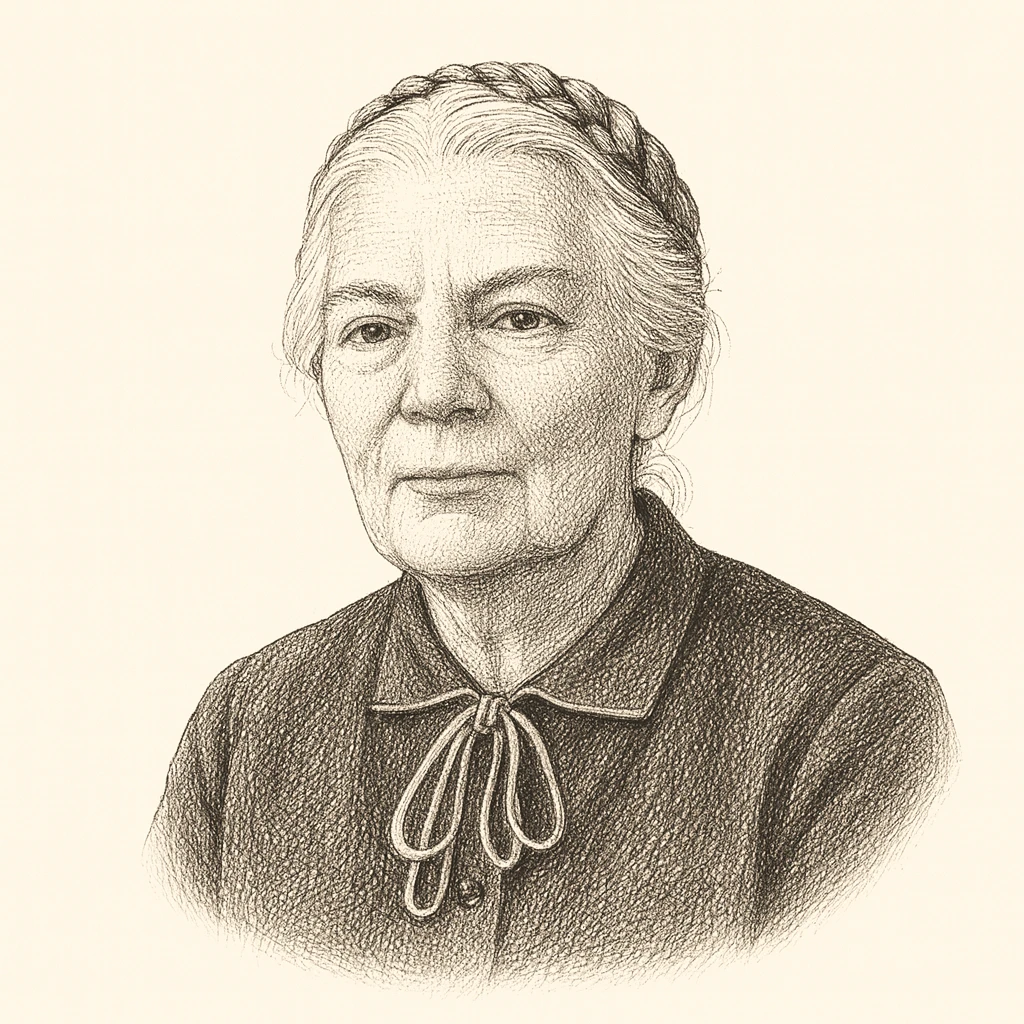
Dorothy Day was born in 1897 in Brooklyn, the third of five children of a sportswriter who moved the family repeatedly — to San Francisco, then to Chicago — in pursuit of work. The family was not religious in any serious sense, and Day grew up without the faith that would eventually organize her life. What she had instead was a powerful conscience, activated early. She remembered walking through Chicago's poor neighborhoods as a child and feeling, with a directness she could not account for, that the poverty she saw was not natural — that it was an offense against something, and that the comfortable acceptance of it by the church people she encountered was itself a form of offense. She attended the University of Illinois for two years on a scholarship before dropping out in 1916 to move to New York, where she threw herself into the bohemian radical culture of Greenwich Village that was then at its most intense and most productive.
The New York years were the years of formation and of damage. She worked as a journalist for socialist newspapers — The Call, The Masses — and was part of a circle that included writers, artists, and activists: Eugene O'Neill, whom she knew well and whose alcoholic despair she witnessed at close range; Mike Gold, the Communist editor who was among her closest friends; John Dos Passos and other figures of the literary left. She was arrested in 1917 in Washington, demonstrating for women's suffrage, and spent thirty days in prison — her first experience of jail, not her last. She had a relationship with a man named Lionel Moise, a journalist of genuine talent and complete emotional unavailability, that ended badly and left her pregnant; she had an abortion, a decision she described in her autobiography with the full weight of its moral consequence, not euphemized and not melodramatized. She later said she believed this was the most profound regret of her life.
She married a man named Berkeley Tobin in 1920, went to Europe with him, came back, and the marriage dissolved. She sold the rights to her autobiographical novel for enough money to buy a small cottage on Staten Island, where she lived with Forster Batterham, a biologist and committed anarchist who loved her but regarded religion with the contempt of a principled naturalist. When their daughter Tamar was born in 1926, Day felt with an urgency she could not resist that the child had to be baptized — that her own gratitude and wonder at the fact of new life demanded a religious response. She had Tamar baptized, and then had herself baptized in 1927. The relationship with Batterham ended; he could not accept her Catholicism, and she could not give up what had become the center of her existence.
The conversion transformed everything and resolved nothing. She was now a Catholic in a Church that was thoroughly at home with capitalism, with private property, with the social order that she had spent her adult life opposing. The priests and bishops she encountered had nothing to say to the political questions that had organized her life. For several years she struggled with this contradiction, praying, working as a journalist, visiting the social Catholic movements of Europe that were trying to develop an alternative, until she met Peter Maurin in 1932. Maurin was a French peasant philosopher in his fifties, a man of evangelical simplicity and genuine learning, who had spent years developing a vision of a green revolution — the building of houses of hospitality for the poor, farming communes, round-table discussions to clarify thought — that he believed was the practical expression of Catholic social teaching. He had been looking for someone to provide the journalistic platform his ideas needed. Day had been looking for someone who could show her how Catholic faith and radical social commitment could be integrated rather than merely coexisting in uncomfortable tension. The collaboration they began in 1933 lasted until Maurin's death in 1949.
The Catholic Worker, launched on May Day 1933, sold for a penny a copy — a price set deliberately to make it accessible to the poor — and quickly achieved a circulation of 100,000. The houses of hospitality followed: places where the hungry could be fed and the homeless sheltered, not as charity administered from above but as community practiced among equals. Day herself lived in the houses, sharing the conditions of those she served, practicing the voluntary poverty that she regarded not as a sacrifice but as a freedom — liberation from the anxiety of acquisition and the dishonesty that property required. The movement grew rapidly; within a few years there were Catholic Worker houses across the country, and it has never entirely disappeared.
Her pacifism was the position that cost her most. She opposed every American war — the Second World War as well as Korea and Vietnam — on the grounds that the weapons and methods of modern warfare were incompatible with the demands of Christian love, regardless of the justice of the cause. This position isolated her from most of the American left during the war years, when opposition to Hitler made pacifism seem morally impossible, and from the mainstream Catholic Church, which supported the war. She held the position without softening it, and she was arrested for civil disobedience as late as 1973, in her mid-seventies, demonstrating with Cesar Chavez's farmworkers in California. She died in 1980, having spent forty-seven years building a movement that had no reliable institutional support and that survived entirely through the willingness of successive generations of volunteers to live by what it preached.
Pope Francis cited her in his address to the United States Congress in 2015 as one of four great Americans, alongside Lincoln, Martin Luther King Jr., and Thomas Merton. Her cause for canonization is open in the Catholic Church; she is referred to by the Vatican as a Servant of God. The combination of radical poverty and pacifism, direct service and political witness, remains the most demanding and least easy to dismiss version of Christian social commitment that American history has produced.
Dorothy Day is associated with Christian Socialist. See the archetype