
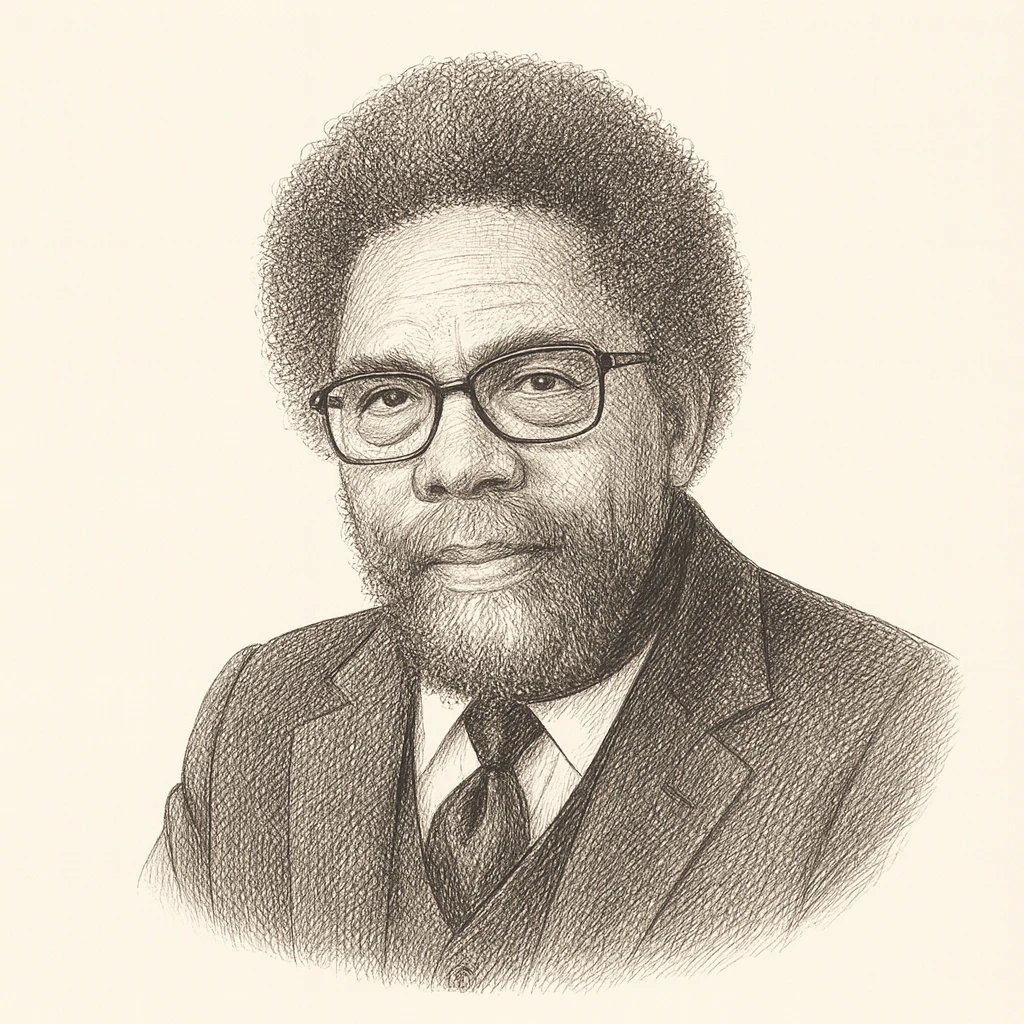
Cornel West is an American philosopher, theologian, and public intellectual whose work synthesizes several traditions: African American prophetic Christianity, American pragmatism, Marxist and democratic socialist thought, and the Black radical tradition. His best-known book, Race Matters, brought his ideas to a wide audience by arguing that America's racial crisis was inseparable from questions of morality, poverty, and what he called "nihilism" in Black communities—a loss of hope and meaning he traced to the pressures of market culture and structural inequality rather than to individual failings. Across his writing he insists that racial justice cannot be separated from economic justice, and he identifies himself explicitly as a democratic socialist.
West draws heavily on American pragmatism, especially the legacy of thinkers like Ralph Waldo Emerson and John Dewey, arguing for a philosophy oriented toward action, democratic participation, and the amelioration of suffering. He frequently frames his politics in the language of the "prophetic"—a tradition of moral witness rooted in the Black church and in figures such as Martin Luther King Jr.—that calls power to account on behalf of the poor and marginalized. This prophetic stance shapes his sharp critiques of what he describes as American empire, militarism, and the corrosive effects of unregulated capitalism, alongside his emphasis on love, justice, and human dignity as political commitments.
A prominent academic who has held positions at institutions including Harvard, Princeton, and Union Theological Seminary, West has combined scholarship with a highly visible role as a commentator and activist. He has been an outspoken critic across party lines, criticizing both conservative and mainstream liberal politics, and he has taken part in electoral politics, including an independent presidential campaign. His willingness to challenge Democratic leaders and figures such as Barack Obama from the left has drawn sharp responses, and it follows from his conviction that political parties should be judged against demands for justice rather than embraced out of loyalty.
West's influence lies less in a systematic political theory than in his role as a bridge between traditions—linking Black liberation thought, the religious left, and socialist critique—and in his insistence that questions of morality, spirituality, and love belong at the center of political life. He has helped keep a prophetic, faith-informed strand of American radicalism visible in public debate.
Cornel West is associated with Christian Socialist. See the archetype