
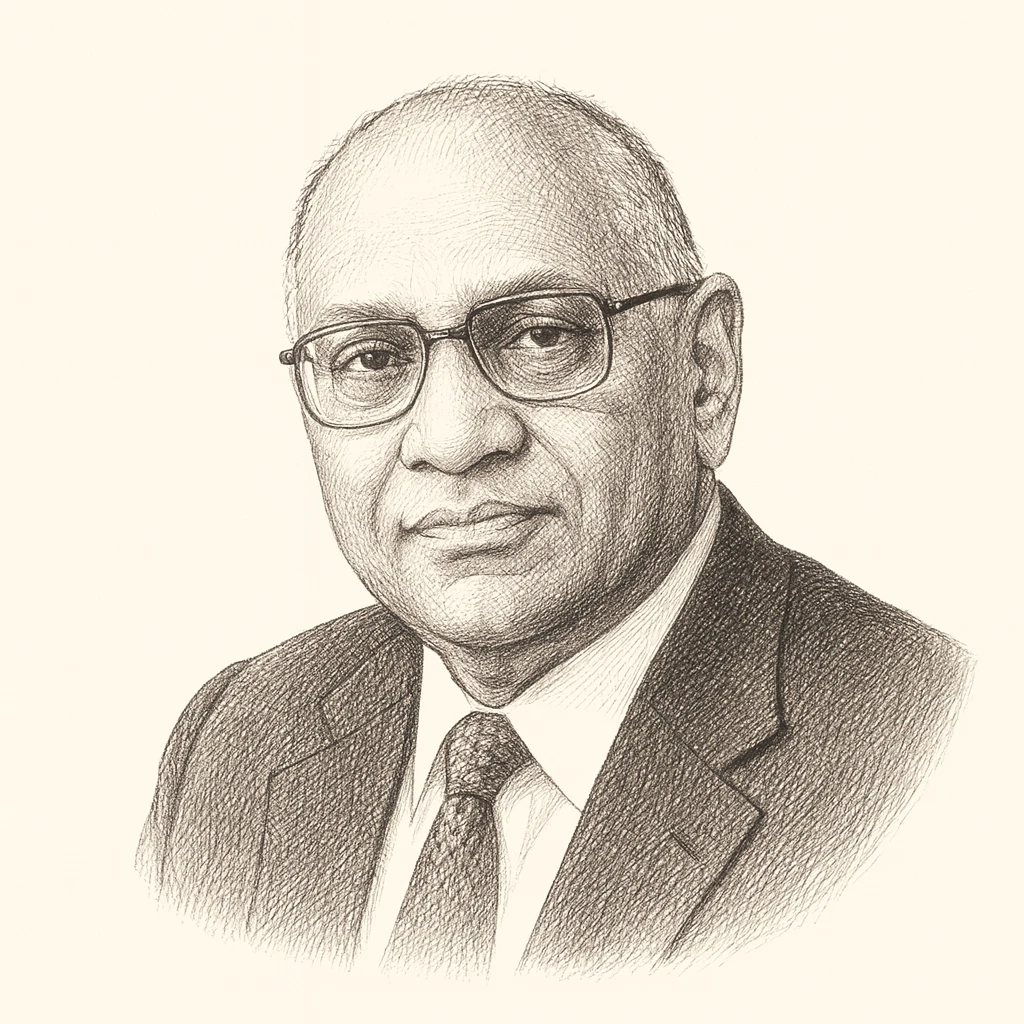
C.K. Prahalad (1941–2010) was an Indian-born management theorist who spent much of his career at the University of Michigan's business school and became one of the most influential thinkers on corporate strategy of his generation. Though best known in the business world—first for the idea of "core competence" developed with Gary Hamel—his later work carried significant implications for how people think about the politics of poverty, development, and the role of private enterprise in society. He is properly understood less as a philosopher in the classical sense than as a strategist whose ideas migrated into political and developmental debate.
Prahalad's most politically consequential contribution was the argument that the world's poorest people, whom he described as the "bottom of the pyramid," should be understood not as passive recipients of aid but as consumers, producers, and entrepreneurs whose collective purchasing power constituted a vast and neglected market. In his best-known book on the subject, he contended that firms could serve the poor profitably while simultaneously reducing poverty, and that dignified inclusion in markets was preferable to dependence on charity or state provision. This reframing challenged both traditional development orthodoxy, which emphasized government and aid, and conventional corporate assumptions that low-income populations were commercially irrelevant.
His thinking aligned with a broader current of market-oriented, private-sector-led approaches to social problems, and it influenced how corporations, development institutions, and social entrepreneurs conceived their responsibilities. Advocates saw in his work a route to poverty alleviation that harnessed business efficiency and innovation; the business scholar Aneel Karnani countered in 2007 that the fortune was a mirage, with a market too small for most multinationals, and that poverty is better reduced by treating the poor as producers rather than as consumers. The debate his ideas provoked—over whether markets or governments are the more effective engine of human development, and over the ethics of commercializing poverty—remains a live one.
Prahalad also engaged with questions of stakeholder value and the purposes of the corporation, contributing to discussions about whether firms owe obligations beyond shareholder returns. Taken together, his work occupies a distinctive place at the intersection of business strategy and political economy: it treats corporations as agents of social transformation and asks how commercial incentives might be aligned with inclusive development. His legacy lies in normalizing the idea that poverty can be addressed through market design rather than only through redistribution or aid.
C.K. Prahalad is associated with Establishment Progressive. See the archetype