
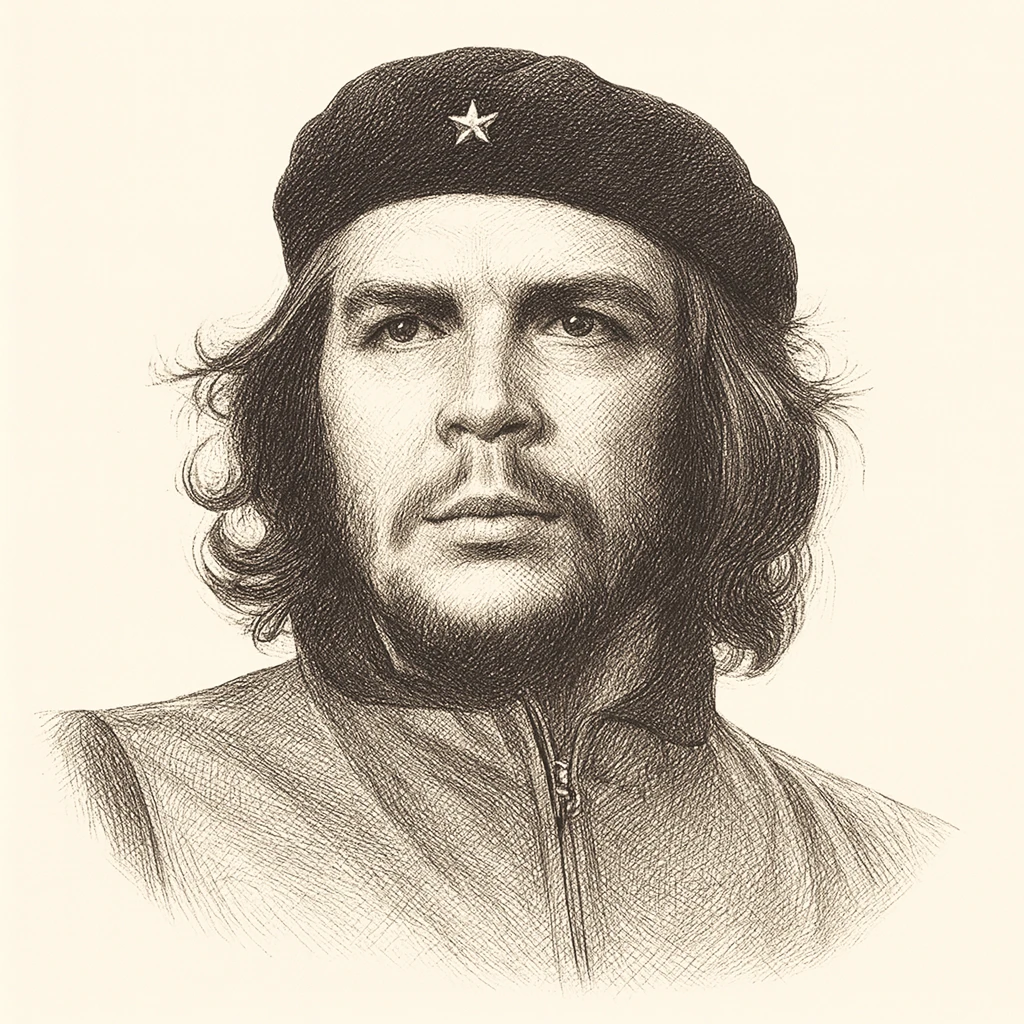
Ernesto 'Che' Guevara was the iconic revolutionary of the 20th century, whose image (beret, beard, defiant stare) became a worldwide symbol of rebellion. An Argentine doctor who joined Fidel Castro's Cuban revolution, Che became the theorist and practitioner of guerrilla warfare worldwide.
Guevara's Motorcycle Diaries described his youthful journey across South America, which radicalized him. In his writings on guerrilla warfare he argued that a small, mobile band of committed fighters, the guerrilla 'foco,' could itself create the conditions for revolution without waiting for objective circumstances to ripen, a doctrine that inspired insurgencies across Latin America and put him at odds with pro-Soviet communist parties that favored longer-term political organizing.
In Cuba, he helped win the revolution, served as president of the national bank and minister of industry, and developed the theory of the 'New Man'—a revolutionary consciousness driven by moral rather than material incentives. Against the use of market mechanisms under socialism, Che favored centralized planning and voluntary labor, holding that socialism required a change in consciousness. In the first months after the revolution he oversaw revolutionary tribunals at La Cabaña fortress that tried former officials and soldiers of the Batista regime and sent many to execution.
Che was also an internationalist who called for the creation of 'many Vietnams' against U.S. power. He left Cuba to spread revolution, failing in the Congo before his final campaign in Bolivia, where he was captured and executed by Bolivian forces with CIA assistance in 1967.
His image, from Alberto Korda's photograph, circulated far more widely after his death than in his lifetime and has been reproduced on posters and t-shirts worldwide.
Che Guevara is associated with Vanguard Collectivist. See the archetype