
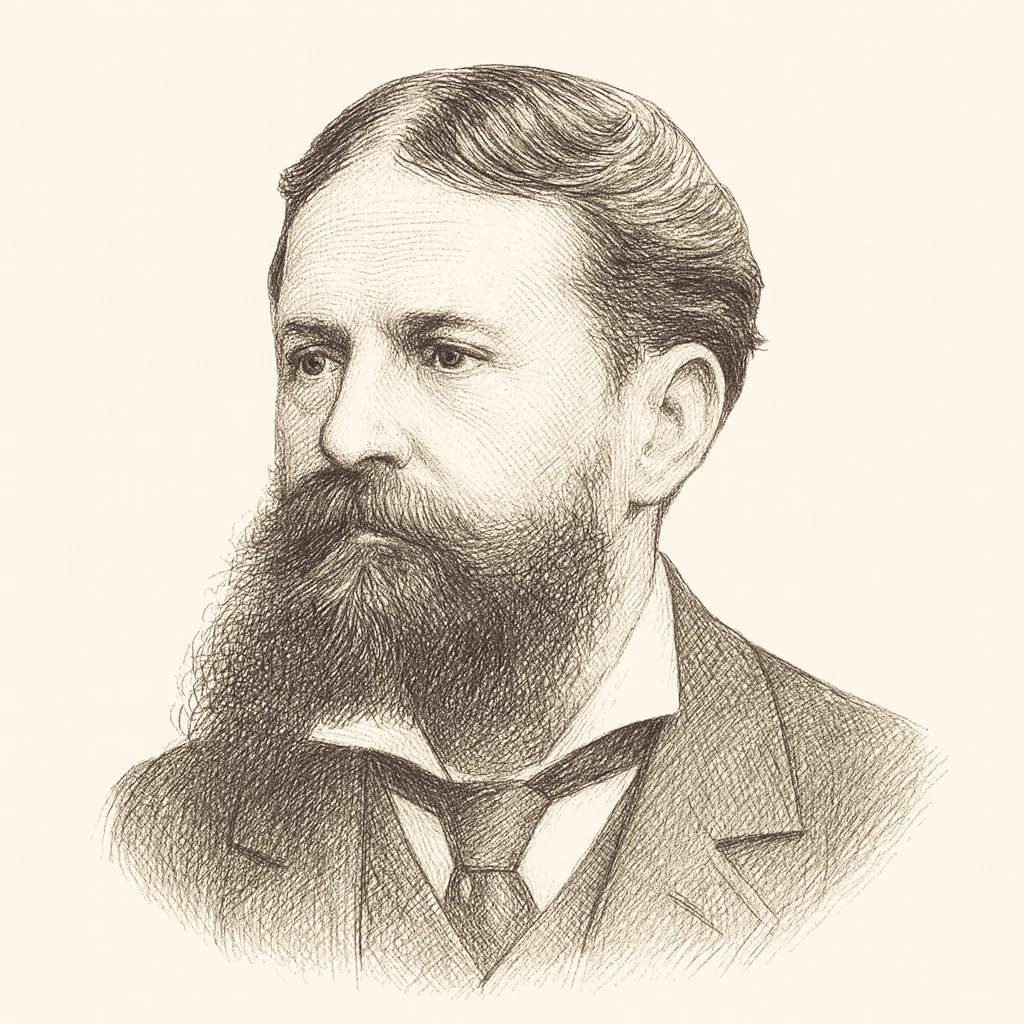
Charles Sanders Peirce was born in 1839 in Cambridge, Massachusetts, the second son of Benjamin Peirce, who was the leading American mathematician of his generation and a professor at Harvard, and Sarah Hunt Mills. He grew up in a household of extraordinary intellectual intensity -- his father ran a kind of informal graduate seminar at their Cambridge home, and by the time Charles was in his teens he had absorbed more mathematics, logic, and natural science than most men twice his age. He studied chemistry at Harvard, graduating in 1859, and then took a degree in philosophy from the Lawrence Scientific School, but his real education was conducted in his father's study, in his own extraordinary reading, and in the conversations with other scientifically and philosophically serious men that his father's position made available.
He worked for the United States Coast Survey from 1861 to 1891 -- thirty years of geodetic measurement, photometric observations of stars, gravity determinations, and the precise scientific work that gave him his understanding of what genuine empirical inquiry looked like in practice. He was one of the most technically accomplished scientists in America during these years, and his scientific work -- particularly his development of methods for determining the shape of the earth through pendulum measurements -- was significant in its own right. At the same time he was doing philosophy: lecturing at Harvard and Johns Hopkins, publishing in philosophical journals, developing the account of logic, signs, and inquiry that would eventually make him the founding figure of American pragmatism and one of the most original philosophers the country produced.
The pragmatist maxim -- the principle that the meaning of any concept lay entirely in the practical consequences of its application -- was formulated in a series of papers published in Popular Science Monthly in 1877-78, particularly "The Fixation of Belief" and "How to Make Our Ideas Clear." The argument was that the difference between two apparently distinct concepts, if they had no difference in their practical consequences, was not a genuine difference in meaning. Metaphysical disputes that turned on distinctions with no practical implications were pseudo-disputes -- confusions produced by the failure to subject concepts to the pragmatic test of what they actually implied for experience. This was a powerful tool for dissolving philosophical problems that had occupied enormous intellectual energy without producing genuine progress, and it was immediately taken up and extended, particularly by William James, who transformed it from a method of clarification into a theory of truth.
Peirce was unhappy with what James made of pragmatism. James's version -- that truth was what worked, that a belief was true if believing it had good consequences for the believer -- seemed to Peirce to confuse the psychological question of what people found satisfying to believe with the logical question of what was actually true. He renamed his own position "pragmaticism," a word "ugly enough to be safe from kidnappers," to distinguish it from the Jamesian version. His account of truth was communal and long-run rather than individual and short-term: truth was what the community of inquirers would ultimately agree on if inquiry continued indefinitely without external constraint. This was not relativism -- it was a demanding account of genuine knowledge as the product of a self-correcting social process that included error and revision as essential components.
His personal life was a sustained catastrophe of his own making. He left his first wife for Juliette Froissy, a French woman he had met and apparently never stopped being devoted to; the relationship scandalized Cambridge society and ended his academic career. When his patron Simon Newcomb forced him out of the Coast Survey in 1891, he had no institutional base. He and Juliette retreated to a farmhouse in Milford, Pennsylvania, which they named Arisbe, and spent the next two decades in increasing poverty and social isolation, with Peirce writing prolifically -- enormous quantities of unpublished manuscripts on logic, semiotics, phenomenology, cosmology, and metaphysics -- and James and other admirers occasionally organizing donations to prevent starvation. He died in 1914, leaving 80,000 pages of manuscripts that Harvard eventually acquired and that scholars are still editing and publishing.
What survived him was more than he knew. His account of inquiry as a social, self-correcting process became foundational for subsequent philosophy of science. His theory of signs -- semiotics -- became foundational for linguistics, literary theory, and communication studies. His pragmatism, transmitted through James and Dewey, shaped American philosophy for the subsequent century. And his personal example -- the most original philosopher America produced, left to die in poverty because his personal conduct violated social convention -- remains a recurring argument about the relationship between institutional structures and genuine intellectual achievement.
Charles Sanders Peirce is associated with Pragmatic Centrist. See the archetype