
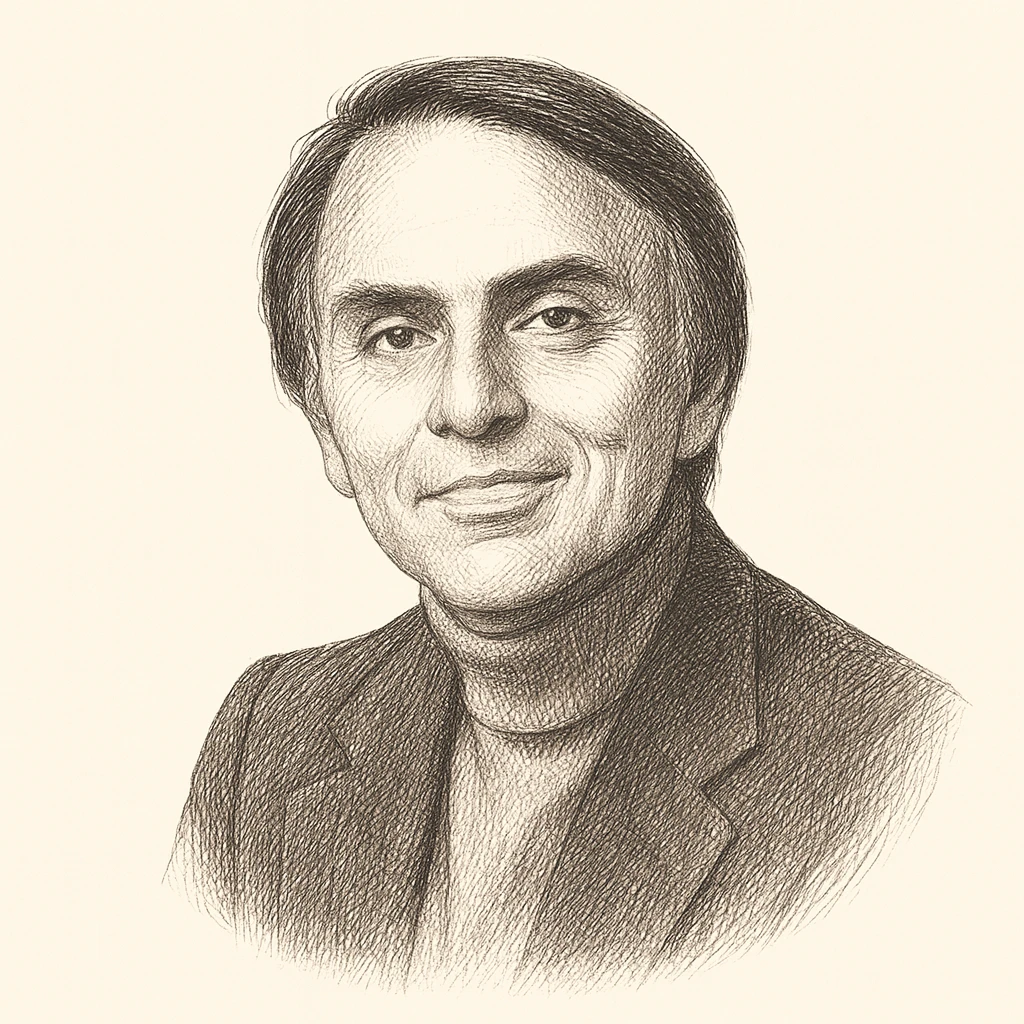
Carl Sagan (1934–1996) was an American astronomer, planetary scientist, and among the twentieth century's most influential popularizers of science. Though not a political theorist, his public work carried a distinctly political dimension: he championed empirical reasoning, skepticism, and the democratic value of a scientifically literate citizenry. Through books and his widely watched television series, he argued that the health of a modern, technological society depended on ordinary people understanding science well enough to make informed decisions. This concern placed him within a broadly Enlightenment tradition that trusts reason, evidence, and open inquiry as safeguards against superstition, demagoguery, and authoritarian manipulation.
Sagan applied these convictions to concrete policy debates. He was a prominent voice on the dangers of nuclear war, associated with research and advocacy warning that a large-scale nuclear exchange could trigger catastrophic climatic effects, an argument that fed into disarmament and arms-control debates during the late Cold War. He was likewise an early public communicator about environmental threats, including concerns about climate and the fragility of Earth's biosphere. His famous reflection on Earth as a small, vulnerable point in the vastness of space became a widely cited image in arguments for global cooperation, humility, and shared responsibility for the planet.
Politically, Sagan is best understood as an advocate for the role of science in a free society rather than a partisan figure. He warned that a public unable to distinguish evidence from pseudoscience and manufactured doubt would be vulnerable to those who exploit ignorance, a theme that has resonated strongly in later debates over misinformation, climate denial, and the erosion of trust in expertise. He emphasized that skepticism must be paired with wonder and openness, guarding against both credulity and cynicism.
Sagan's enduring political influence lies less in a specific ideology than in a civic ethic: the idea that democratic self-governance requires critical thinking, transparency, and a citizenry equipped to reason about complex technical questions. His work has been invoked by advocates of science-informed policymaking, secular humanism, environmental protection, and international cooperation. In debates about the proper relationship between science and public life, he remains a touchstone for those who see the cultivation of reason and evidence as essential to a functioning, humane, and resilient political order.
Carl Sagan is associated with Techno-Progressive. See the archetype