
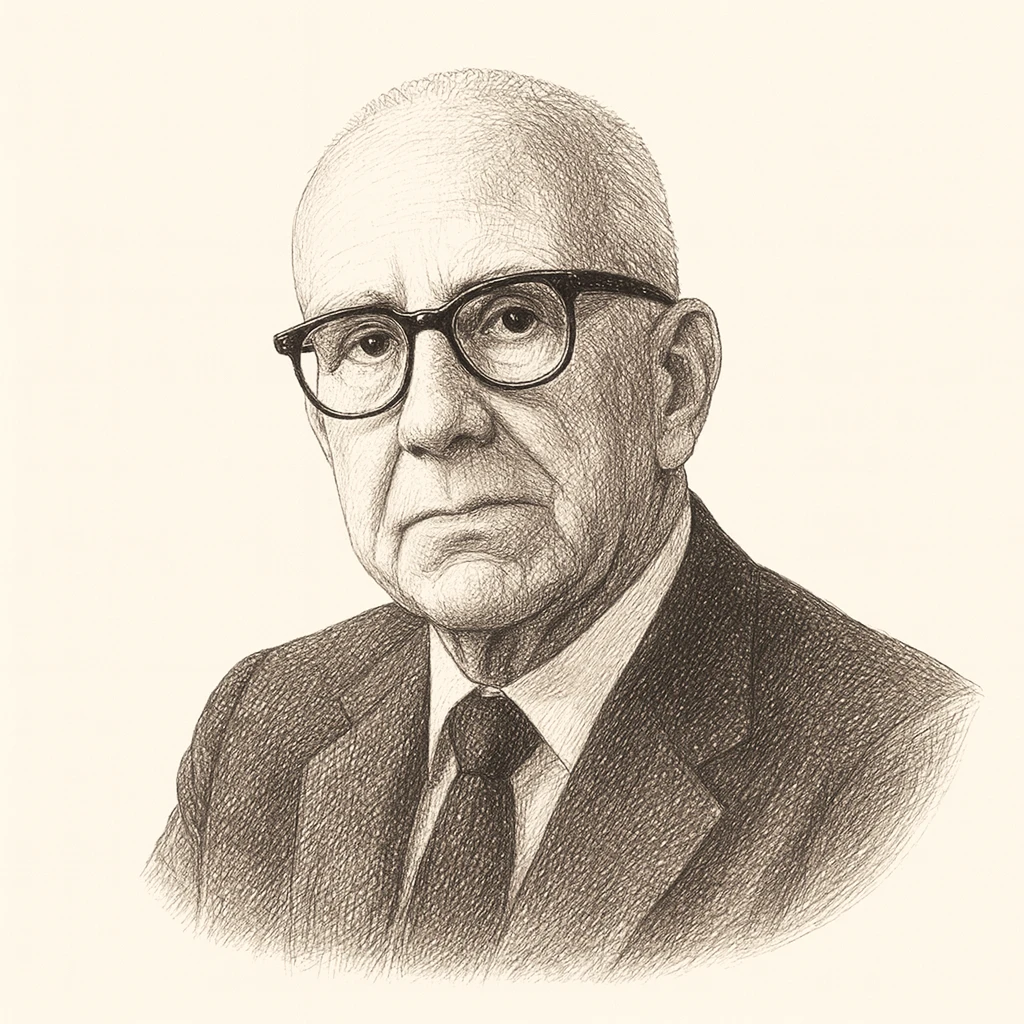
R. Buckminster Fuller (1895–1983) was an American designer, architect, inventor, and systems thinker whose political vision emerged not from party or ideology but from what he called "comprehensive anticipatory design science." Best known for popularizing the geodesic dome, Fuller framed the world's problems as fundamentally technical and organizational rather than moral or partisan. He argued that scarcity was largely a design failure, and that intelligent application of technology and resources could lift all of humanity to a decent standard of living. This conviction placed him outside the conventional left-right spectrum: he distrusted politicians and states as agents of change, believing that innovation in tools and systems would render obsolete the conflicts that politics sought to manage.
Central to Fuller's thought was the concept of "ephemeralization"—the idea that technological progress allows humanity to do progressively more with less material, energy, and time. From this he drew an optimistic conclusion: humanity could move from an assumption of inevitable scarcity, which he associated with historical struggles over limited resources, toward a condition of potential universal abundance. He also popularized the image of "Spaceship Earth," the notion that the planet is a finite, integrated system whose passengers share a common fate and must manage their collective resources wisely. This metaphor became influential in environmental and global-governance discourse, encouraging people to think about politics in planetary rather than merely national terms.
Fuller's outlook was resolutely internationalist and technocratic. He was skeptical of ideological politics, weaponry, and what he saw as wasteful competition among nations, contrasting these with cooperative, resource-conscious problem-solving. His work anticipated later concerns with sustainability, systems thinking, and whole-earth stewardship, and he became a touchstone for parts of the 1960s and 1970s counterculture, appropriate-technology movements, and futurist thinkers.
His political legacy remains ambiguous and much debated. Admirers see in him a prophet of ecological limits and post-scarcity possibility; critics regard his faith in design and technology as naïve technological utopianism that underestimated power, politics, and distributional conflict. Either way, Fuller helped shape a durable strand of thought that treats governance as a challenge of managing a shared planetary system, and that locates hope for humanity in ingenuity rather than in traditional political struggle.
Buckminster Fuller is associated with Techno-Progressive. See the archetype