
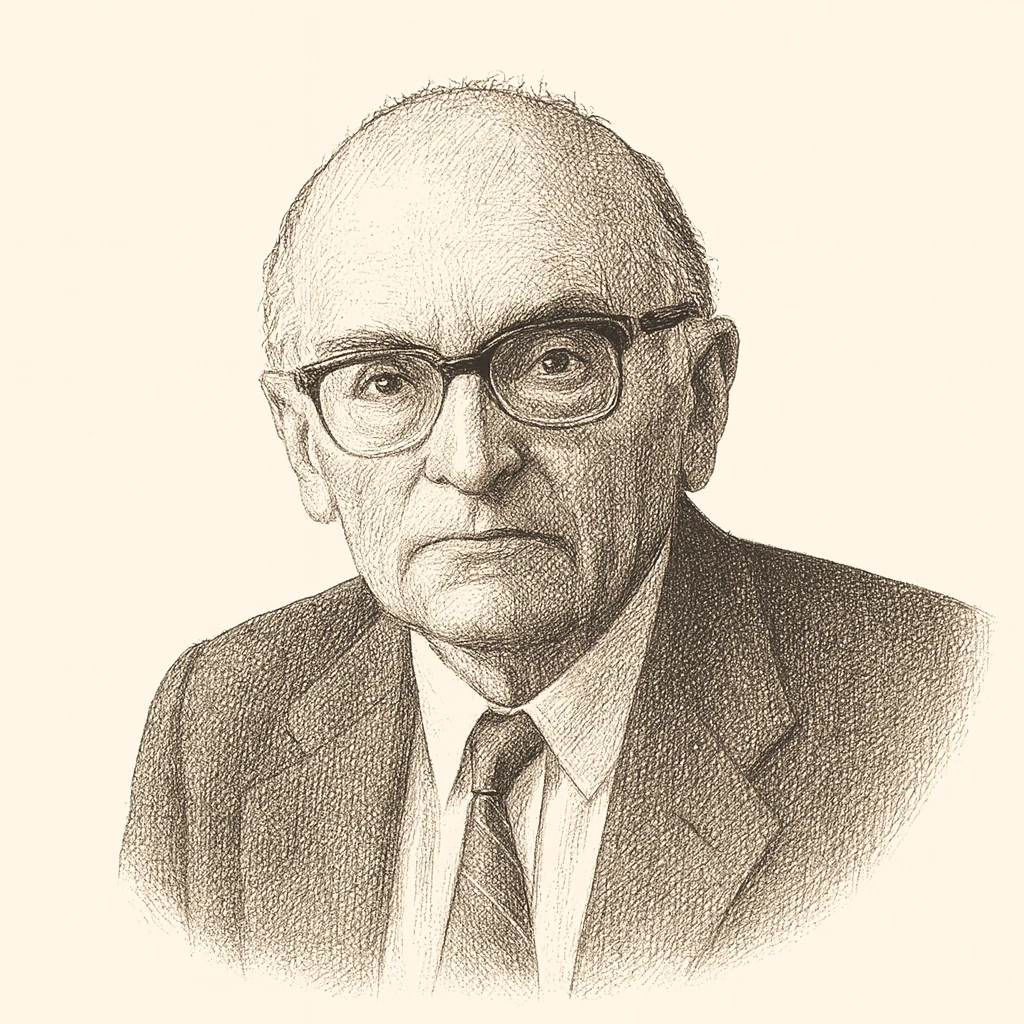
Branko Horvat (1928–2003) was among the most prominent economists associated with Yugoslav self-management socialism, the distinctive model that set post-1948 Yugoslavia apart from the Soviet-style command economies of the Eastern Bloc. Working in the space opened by the country's break with the Soviet Union, Horvat sought to give theoretical rigor to the idea that socialism need not mean central planning by the state. His central concern was to define an economic order in which enterprises were governed by their workers rather than by private owners or a state bureaucracy, and in which markets served as a mechanism of coordination without capitalist ownership of the means of production.
Horvat's political thought placed the labor-managed firm at the center of a democratic economy. He argued that self-management was not merely an administrative arrangement but a principle of freedom, extending democratic participation from the political sphere into the workplace and the wider economy. In this he drew on and elaborated the Marxist and socialist traditions while breaking sharply with authoritarian, statist interpretations of socialism. He treated efficiency and democracy as complementary rather than opposed, contending that firms controlled by their workers could be both more just and economically viable, provided they operated within an appropriate institutional framework combining markets, social ownership, and public coordination.
Alongside his academic work, Horvat was a public intellectual and, in the later part of his life, a political figure engaged in debates over the direction of the region. He was known internationally as a leading voice in the theory of market socialism and the economics of self-management, and his work was widely read by scholars interested in alternatives to both centrally planned socialism and Western capitalism. His writing on the political economy of socialism became a reference point for debates about whether a socialism both democratic and market-compatible was possible.
Horvat's enduring influence lies in the way he pressed the question of economic democracy: who should control production, and on what terms. For thinkers exploring cooperatives, workplace democracy, and post-capitalist institutional design, his systematic defense of labor-managed enterprise remains a significant intellectual resource, even as the Yugoslav experiment he theorized ultimately dissolved.
Branko Horvat is associated with Market Socialist. See the archetype