
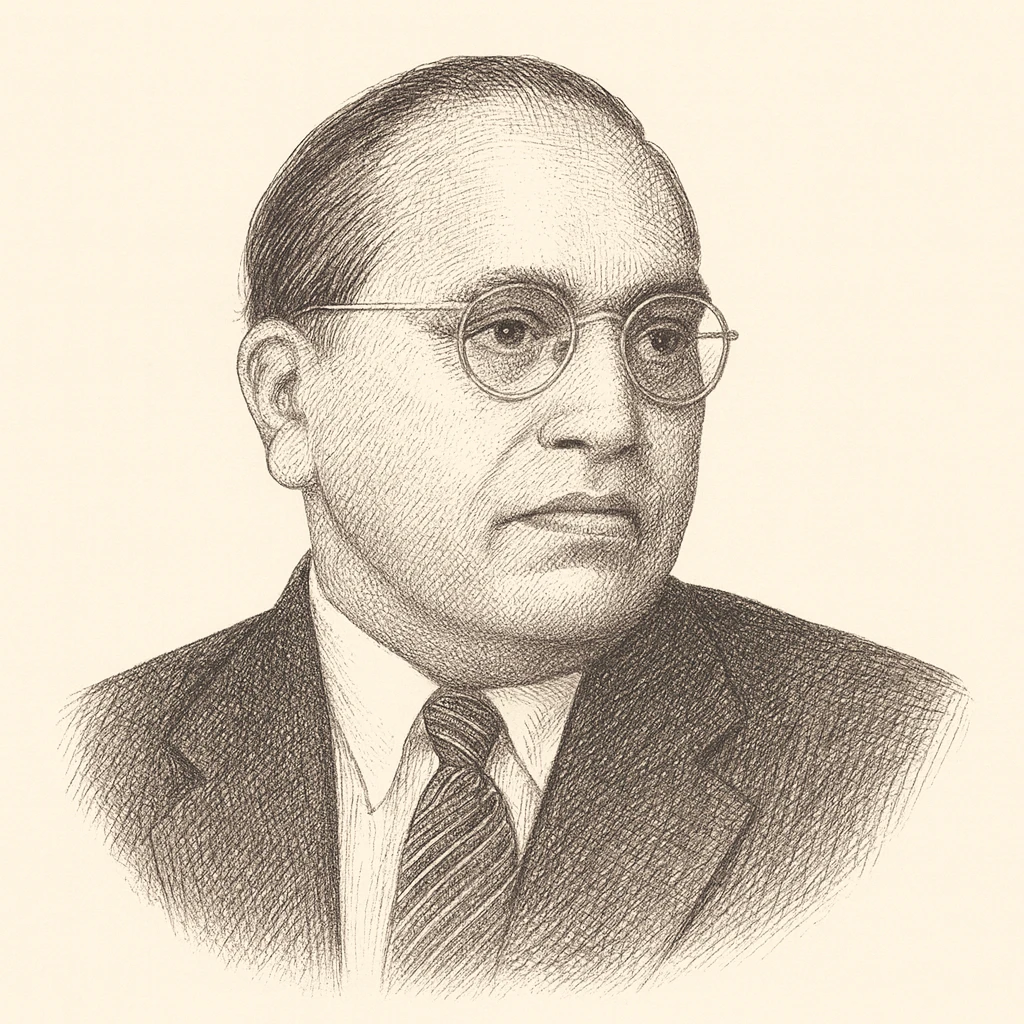
Bhimrao Ramji Ambedkar was an Indian jurist, economist, and social reformer whose thought placed the eradication of caste hierarchy at the center of any credible vision of political freedom. Born into a Dalit ('untouchable') family and educated at Columbia University and the London School of Economics, he argued that formal political rights meant little without social and economic equality. For Ambedkar, liberty, equality, and fraternity were inseparable: constitutional guarantees would ring hollow in a society structured by graded inequality, and true democracy required the dismantling of caste as a system of ranked domination sustained by religion and custom.
His most influential polemic argued that caste could not be reformed from within but had to be abolished at its roots, which led him to challenge the scriptural and social foundations that legitimized it. He was sharply critical of Gandhi's approach to caste and untouchability, insisting that Dalits needed independent political representation and legal protection rather than paternalistic uplift. This dispute over separate electorates and the terms of Dalit political agency became one of the defining debates of the independence era, and Ambedkar consistently prioritized the concrete emancipation of the oppressed over appeals to national unity that left hierarchy intact.
As chairman of the drafting committee of India's constitution, Ambedkar shaped a framework that combined liberal individual rights with affirmative measures for historically excluded groups, embedding the abolition of untouchability and provisions for reservations into the fundamental law. He saw the constitution as an instrument for social transformation, though he also warned that constitutional democracy would remain fragile so long as Indian society tolerated deep inequality. Late in life he converted to Buddhism along with many followers, framing it as an ethical and egalitarian alternative to caste-bound tradition.
Ambedkar's legacy is contested and expansive: he is claimed by liberals, socialists, and Dalit movements alike, and his insistence that political democracy must be underwritten by social justice continues to inform debates over rights, group representation, and the limits of majoritarianism in India and beyond.
B.R. Ambedkar is associated with Social Liberal. See the archetype