
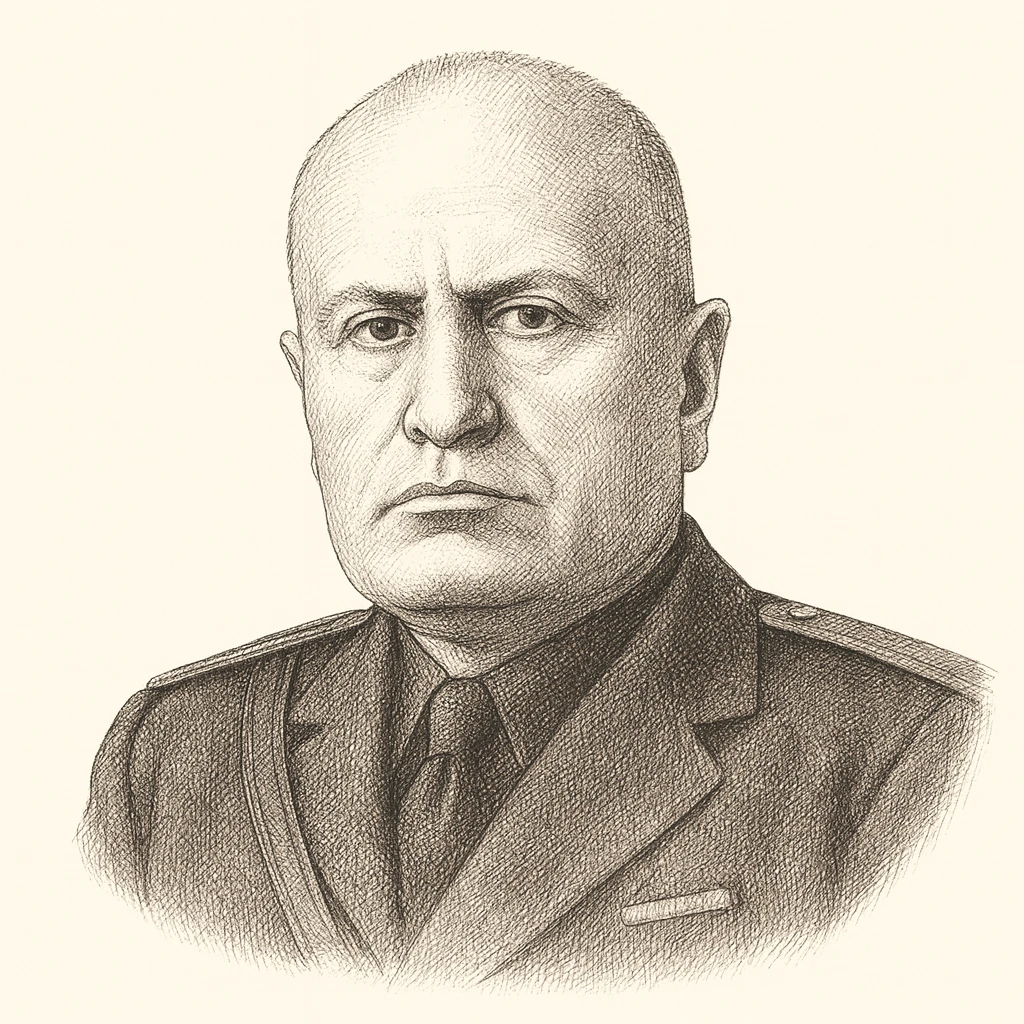
Benito Mussolini was the founder of fascism and dictator of Italy from 1922 to 1943, creating a model of authoritarian nationalism that influenced movements worldwide, including Nazism. Originally a socialist journalist—editor of the party newspaper Avanti!—Mussolini broke with the left over World War I. Whereas orthodox socialists opposed the war as a capitalist venture, he came to see national mobilization and revolutionary violence as forces that could remake society, embracing nationalism and founding the Fascist movement in 1919.
Fascist thought, which Mussolini developed less as a coherent doctrine than as a practice justified after the fact, rejected both liberal individualism and Marxist class struggle. In their place it exalted the nation as an organic whole and the state as the supreme expression of collective will. Fascism promised national renewal through strength, unity, and action rather than liberal democracy's perceived weakness, elevating myth, discipline, and the leader over reasoned debate and parliamentary compromise. This drew on currents already circulating in early twentieth-century Europe—nationalism, syndicalism, and a cult of vitality and struggle—which Mussolini fused into a movement.
The March on Rome in 1922 brought Mussolini to power. He dismantled democracy, creating a one-party state with corporatist economics, aggressive nationalism, and a cult of personality around 'Il Duce.' Corporatism claimed to transcend class conflict by organizing employers and workers into state-supervised bodies, presenting itself as a 'third way' between capitalism and socialism, though in practice it subordinated labor and preserved private ownership under state direction.
Mussolini's imperial ambitions led to the conquest of Ethiopia and alliance with Nazi Germany. The Ethiopian war, waged with great brutality, defied the League of Nations and drew Italy closer to Hitler, whose regime had borrowed heavily from the fascist example even as it radicalized it. Italy's military failures in World War II led to his overthrow in 1943. Rescued by Germans, he led a puppet state until partisans captured and executed him in 1945. His body was hung upside down in Milan—an ignominious end for the man who invented fascism.
Mussolini's legacy is his creation of fascism itself as a political category, one that later movements imitated and that scholars have since studied as a distinct form of authoritarian mass politics. His example remains a reference point in debates over nationalism, dictatorship, and the fragility of democratic institutions.
Benito Mussolini is associated with Reactionary Strongman. See the archetype