
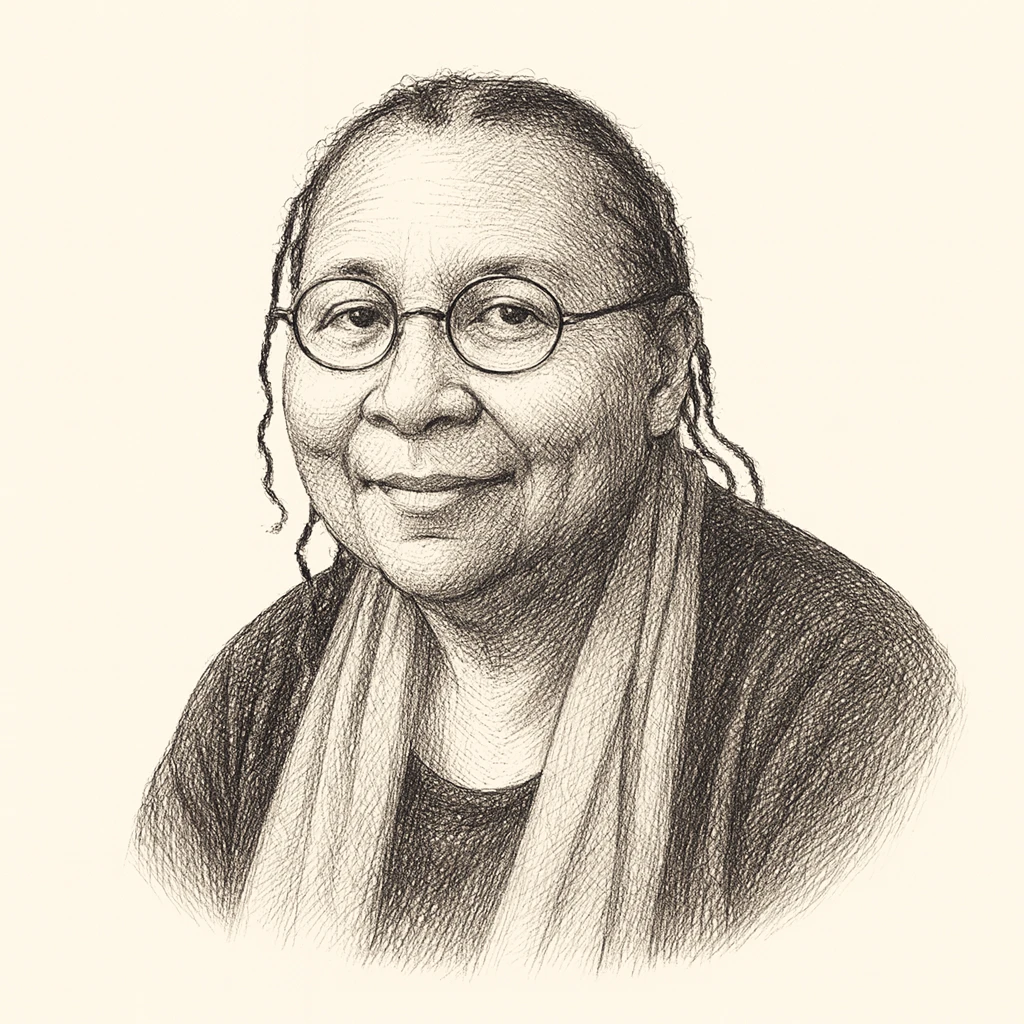
bell hooks—the pen name of Gloria Jean Watkins, styled lowercase to shift attention from the author to her ideas—was a writer and theorist whose work became foundational to Black feminist thought in the United States. Her early book Ain't I a Woman: Black Women and Feminism argued that mainstream feminism had centered the experiences of white, middle-class women while neglecting the distinct position of Black women, and that racism and sexism could not be understood in isolation. This insistence on analyzing oppression as layered rather than singular made her an important voice in the broader turn toward intersectional analysis in feminist and anti-racist politics.
Across a large body of accessible, essayistic writing, hooks developed the idea of an "imperialist white-supremacist capitalist patriarchy"—a phrase meant to capture how systems of domination reinforce one another rather than operating separately. She argued that liberation required confronting all of these at once, and she was pointed in her critiques of feminism that stopped at legal or economic parity without challenging capitalism, race hierarchy, and cultural norms. Her writing on education, drawing on the tradition of critical pedagogy associated with Paulo Freire, framed the classroom as a site where students could practice freedom and question received power.
A distinctive strand of her later work treated love as a political and ethical practice rather than a purely private feeling. In All About Love and related books she argued that a culture organized around domination corrodes the capacity to love, and that building an "ethic of love" was inseparable from justice. She extended this to masculinity, contending that patriarchy harms men as well as women by cutting them off from emotional life. These arguments broadened her audience well beyond the academy.
hooks's ideas have been contested and debated, with objections to the analytic precision of her sweeping systemic categories and her sometimes generalizing claims, but her influence on how activists and readers think about the connections between race, gender, class, and everyday relationships is widely acknowledged. She remains a touchstone for those who see personal transformation and structural critique as parts of a single project.
bell hooks is associated with Progressive Activist. See the archetype