
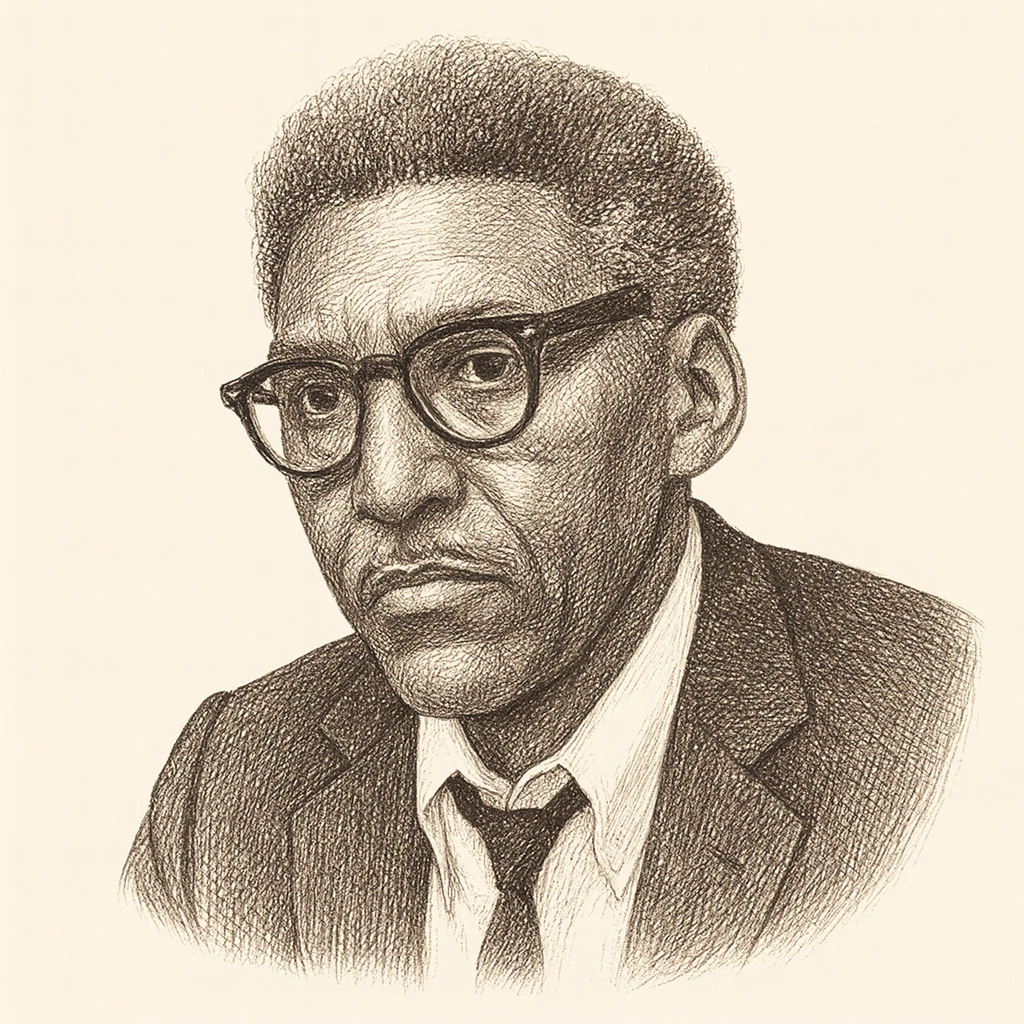
Bayard Rustin was a strategist and theorist of nonviolent direct action whose political thought bridged the American labor movement, democratic socialism, and the struggle for racial equality. Trained in the Quaker tradition and shaped by his early involvement in pacifist organizations, he argued that nonviolence was not merely a moral stance but a disciplined political method capable of confronting entrenched power. He was among the figures who helped introduce Gandhian techniques into the American civil rights movement, and he became a close adviser to Martin Luther King Jr., counseling him on the organizational and philosophical foundations of nonviolent protest.
Rustin's best-known achievement was his role as chief organizer of the 1963 March on Washington for Jobs and Freedom, a feat of logistical coordination that reflected his broader conviction that mass mobilization had to be paired with careful strategy and broad alliances. His thinking increasingly emphasized coalition politics: he argued that lasting gains for Black Americans depended on building durable partnerships with organized labor, liberals, and religious groups, and on shifting from protest toward the sustained work of winning economic and political power. This led him to stress full employment, union strength, and structural economic reform as inseparable from civil rights—a democratic-socialist vision of racial justice grounded in material redistribution.
His coalition-oriented approach placed him in tension with more militant currents of the later 1960s. Critics on the left faulted his emphasis on working within the Democratic Party and existing institutions, and his positions on some foreign-policy questions and on episodes such as the Vietnam-era debates drew sharp disagreement. As an openly gay man in an era of intense hostility, Rustin was frequently pushed to the margins of the movements he served, and his sexuality was used against him by opponents; late in life he became an increasingly public advocate for gay rights, framing it as part of the same commitment to human dignity that animated his earlier work.
Rustin's enduring influence lies in his insistence that moral vision must be joined to organizational discipline and political coalition-building, and in his argument that racial and economic justice are ultimately the same fight. He is remembered as a link between the pacifist, socialist, and civil rights traditions, and as a figure who modeled how a committed radical could operate as a pragmatic strategist.
Bayard Rustin is associated with Democratic Socialist. See the archetype