
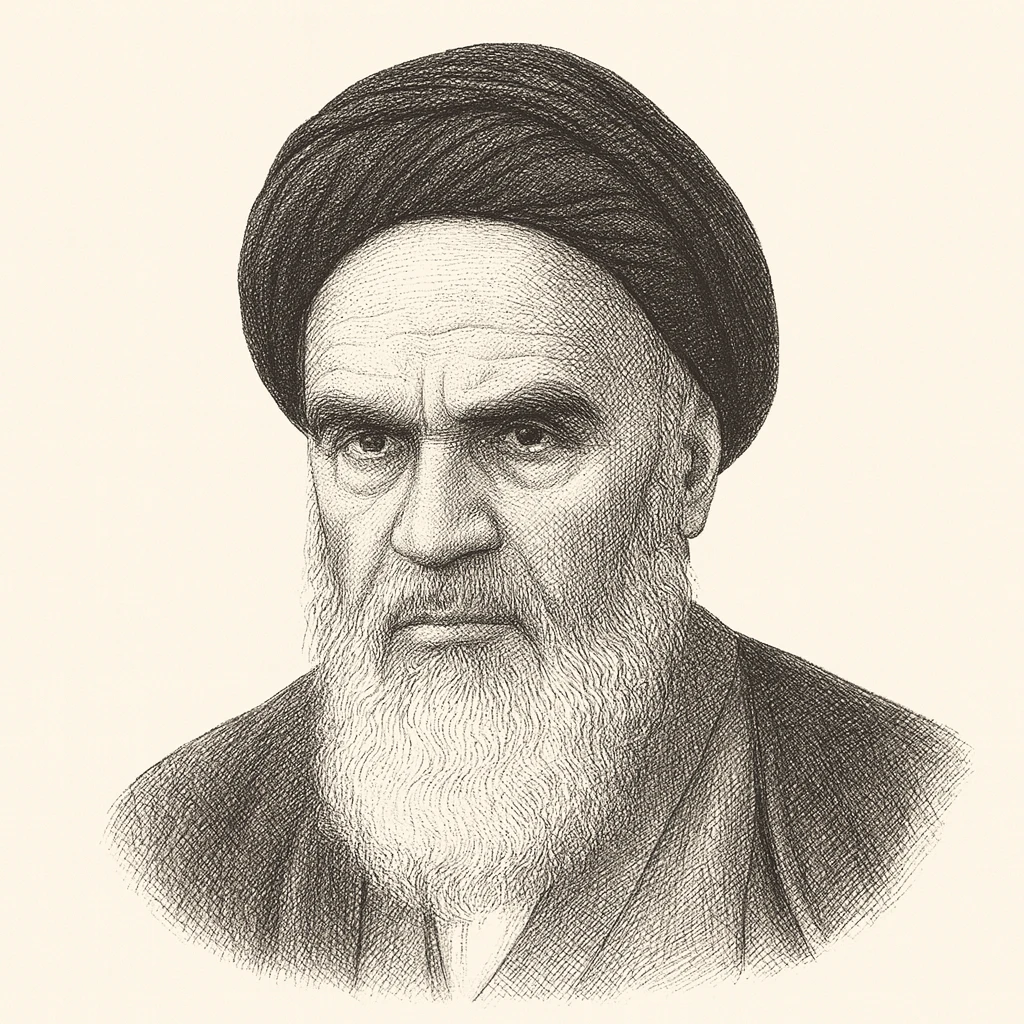
Ayatollah Ruhollah Khomeini was the religious leader who led the Iranian Revolution of 1979, overthrowing the Shah and establishing an Islamic Republic that fundamentally challenged both Western liberalism and secular nationalism. A senior Shia cleric, Khomeini was exiled in 1964 for opposing the Shah's reforms but continued to inspire opposition from Iraq and then France.
Khomeini's principal doctrinal step was to break with the quietist tradition that had long prevailed in Shia Islam, under which most clerics stayed out of politics during the absence of the Hidden Imam. In lectures delivered during his exile in Najaf, he argued that in the Imam's absence a qualified jurist must assume political authority to apply Islamic law—the doctrine of velayat-e faqih (guardianship of the jurist). Monarchy, he contended, was inherently illegitimate, and only rule by the learned could realize a just Islamic order.
The 1979 revolution united diverse opposition groups (Islamists, leftists, liberals, nationalists), but Khomeini outmaneuvered secular allies to establish clerical rule. The new constitution made him Supreme Leader with authority over all state institutions, embedding velayat-e faqih as the state's founding principle. His rhetoric fused religious duty with anti-imperialism, mobilizing the oppressed (mostazafin) against domestic tyranny and foreign domination, and casting the United States as the "Great Satan."
Khomeini's Iran challenged both superpowers, taking American hostages and fighting Saddam Hussein's Iraq for eight years. His 1989 fatwa calling for the death of Salman Rushdie over The Satanic Verses provoked an international crisis. His doctrine met opposition inside the clerical establishment: Grand Ayatollah Mohammad Kazem Shariatmadari opposed his rule, arguing that merging religion and government would corrupt both, and was placed under house arrest. The government imprisoned and executed thousands of political opponents, including the mass execution of political prisoners in 1988; Ayatollah Hossein-Ali Montazeri, his designated successor, protested those killings and was removed as heir.
Khomeini died in 1989, having created a durable theocratic system that survived his death and passed to a successor Supreme Leader. His Islamic Revolution reshaped Middle Eastern politics and offered a model of religiously grounded governance that Shia Islamist movements outside Iran took up.
Wondering where you land? Take the 4-minute assessment