
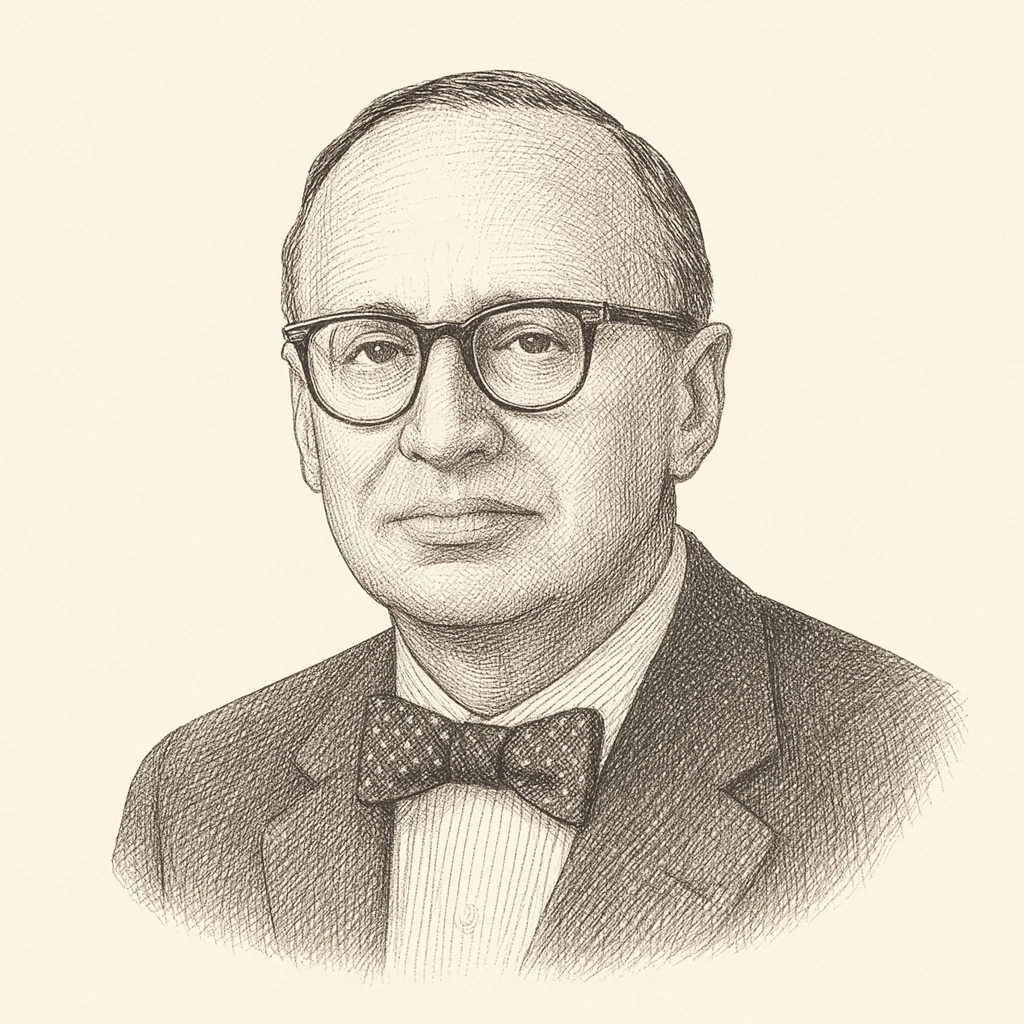
Arthur M. Schlesinger Jr. (1917–2007) was among the most influential American historians and liberal public intellectuals of the twentieth century. His political thought is most closely associated with his book The Vital Center (1949), which argued that democratic liberalism should position itself as a fighting, non-totalitarian middle ground—firmly opposed to both fascism and communism, and skeptical of utopian ideologies of every kind. This vision cast liberalism not as a soft compromise but as a tough-minded, pragmatic tradition committed to individual freedom, pluralism, and the mixed economy of the New Deal.
Schlesinger's historical writing reinforced this outlook. In studies of the Jacksonian era and of the Roosevelt presidency, he interpreted American history as a recurring struggle to use democratic government as a check on concentrated economic power, portraying reform liberalism as central to the national tradition. He also advanced an influential theory of cycles in American politics, suggesting that periods of public purpose and reform alternate with periods of private interest and conservatism—an idea that shaped how many observers thought about the rhythm of political change.
He was not only a scholar but an active partisan of the causes he described. Schlesinger helped found Americans for Democratic Action, an organization that sought to define a liberalism independent of communist influence, and he served as an adviser and aide in the Kennedy administration, later writing a prominent insider history of that presidency. In his later work he became a sharp critic of the expansion of executive power, warning that the presidency had accumulated dangerous authority, particularly in matters of war—an argument that entered lasting debates about the balance of powers in American government.
Schlesinger's broader significance lies in his articulation and defense of Cold War liberalism: a creed combining anti-communism abroad with activist reform at home, grounded in a wary view of human nature and a preference for practical problem-solving over ideological purity. His writings also engaged debates over national identity, and he cautioned against currents he believed fragmented common civic bonds. Both celebrated and criticized, he remains a defining voice for understanding how American liberals thought about their own tradition in the decades after World War II.
Arthur Schlesinger Jr. is associated with Pragmatic Centrist. See the archetype