
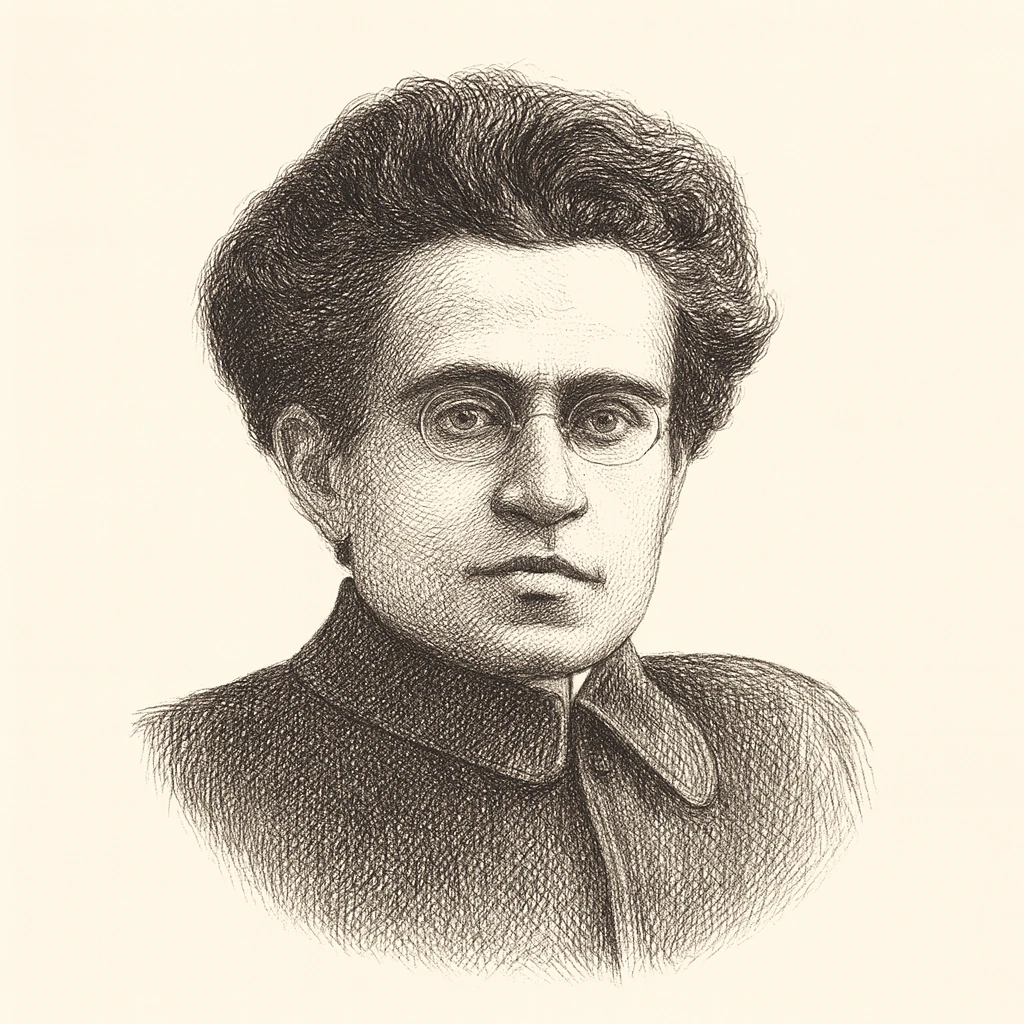
Antonio Gramsci was the most original Marxist theorist of the 20th century and one of the most influential political thinkers of any tradition in the last hundred years. His central insight — that ruling classes maintain their power not primarily through force but through cultural, intellectual, and institutional means that produce active consent from the ruled — reshaped Marxist theory, anticipated much of what would become cultural studies, and provided the analytical framework for both left-wing politics and (in unexpected ways) much contemporary right-wing cultural criticism. All of this despite the fact that Gramsci's most important writings were smuggled out of a fascist prison in tiny notebooks, unfinished, fragmentary, and never intended for publication.
Gramsci was born in 1891 in Sardinia, one of the poorest regions of newly unified Italy, into a family that was sliding into poverty after his father was imprisoned on corruption charges. He was a sickly child with a spinal deformity that stunted his growth and left him in chronic pain for the rest of his life. He was also extraordinarily intelligent, and scholarships carried him through school and eventually to the University of Turin, where he encountered the revolutionary politics of the northern Italian industrial working class and became a committed socialist. When the Italian Socialist Party fractured in the aftermath of the Russian Revolution, Gramsci helped found the Italian Communist Party in 1921 and became its leader by 1924.
His political career was cut short by the rise of Mussolini's fascism. In 1926, despite his parliamentary immunity, Gramsci was arrested by the fascist regime and sentenced to twenty years in prison. The prosecutor famously declared, "For twenty years we must stop this brain from functioning." It did not work. In prison, despite deteriorating health, terrible conditions, and the constant surveillance of fascist censors, Gramsci wrote what became known as the Prison Notebooks: over 3,000 pages of fragmentary theoretical reflections on Marxism, Italian history, philosophy, culture, and political strategy. The notebooks were smuggled out piece by piece, preserved by his family, and eventually published in the 1940s and 50s after the fall of fascism. Gramsci himself did not live to see any of it. His health collapsed in prison, and he died in 1937 at forty-six, having been released to a clinic only days before his death.
Gramsci's central theoretical contribution was the concept of cultural hegemony. Classical Marxism had tended to see ruling-class power as operating primarily through the state's coercive apparatus — police, courts, military, prisons. Gramsci argued this missed most of what kept ruling classes in power in modern Western societies. More important than coercion was what he called hegemony: the ruling class's ability to present its own interests, values, and worldview as natural, universal, and common-sensical. Through schools, churches, newspapers, cultural institutions, and everyday patterns of life, the ruling class's perspective became the shared perspective of the whole society, so that workers came to accept their subordinate position not because they were forced to but because they themselves believed this was how the world worked and how it should work. Hegemony was consent, manufactured through cultural means, and it was far more stable than coercion because it operated in the minds of the ruled rather than at the end of a policeman's baton.
This framework had enormous implications for political strategy. If hegemony was the primary mechanism of ruling-class power, then revolutionary politics could not simply aim at seizing the state. It had to fight a long struggle within civil society, working to build counter-hegemonic institutions, counter-narratives, and counter-cultures that could challenge dominant assumptions and prepare the ground for eventual political transformation. Gramsci called this strategy a "war of position" (as opposed to the "war of maneuver" of direct revolutionary assault), and it became the dominant strategic framework for left-wing politics throughout the late 20th century.
The influence of Gramsci's framework extends far beyond explicitly Marxist politics. Cultural studies as an academic discipline was built substantially on Gramscian foundations. Contemporary debates about media representation, cultural power, and ideological influence routinely draw on Gramscian concepts. And in one of the more unexpected intellectual developments of recent decades, much contemporary right-wing cultural criticism — particularly debates about "cultural Marxism," "the long march through the institutions," and the supposed capture of cultural institutions by progressive ideology — operates within unmistakably Gramscian categories even when it is being used against left-wing targets. Gramsci's analysis of how cultural power works has proven more durable than the specific political project he hoped to serve with it.
Antonio Gramsci is associated with Democratic Socialist. See the archetype