
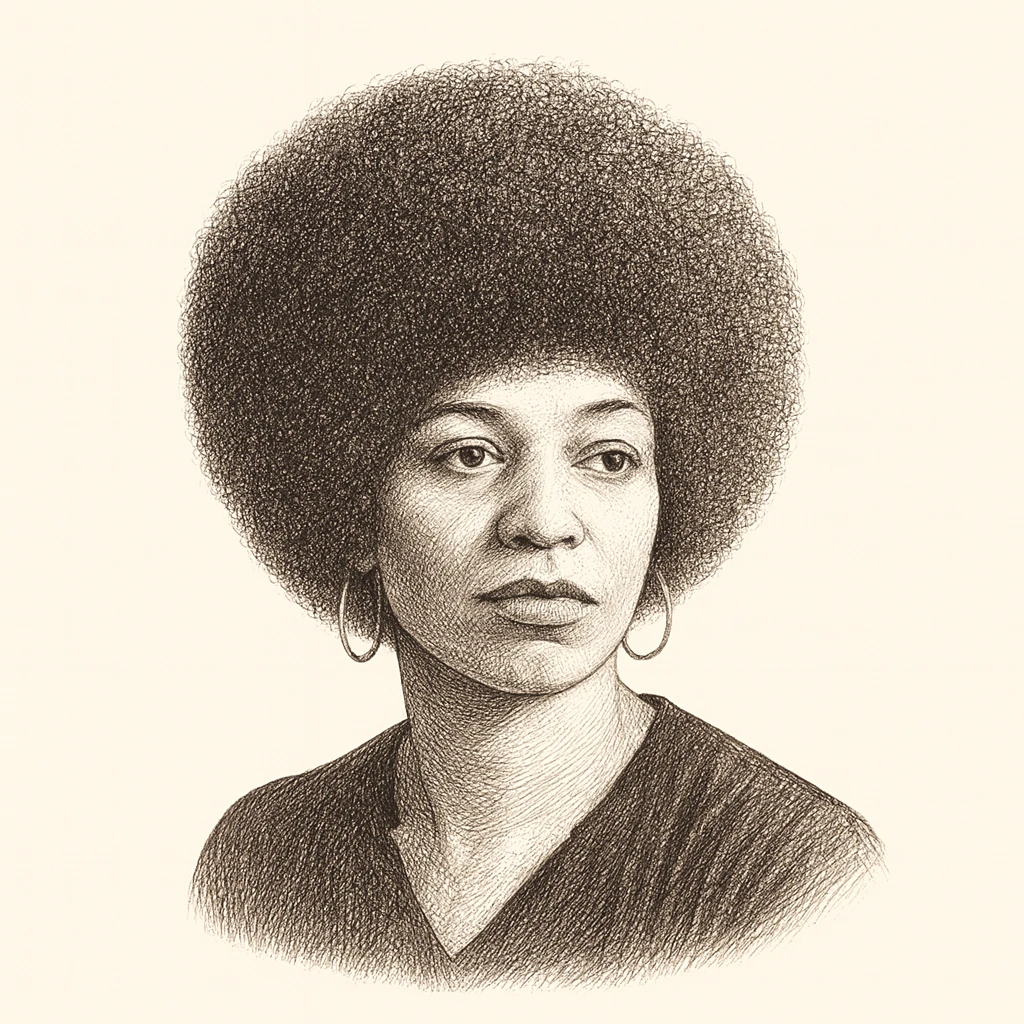
Angela Davis emerged as a public intellectual and activist at the intersection of Marxism, Black liberation, and feminism. Trained in philosophy—she studied under thinkers associated with the Frankfurt School, including Herbert Marcuse—she brought a rigorous critical-theory sensibility to American radical politics. A member of the Communist Party USA until 1991 and briefly associated with the Black Panther Party, she argued that racial oppression could not be understood apart from the structures of capitalism, and that liberation required confronting class exploitation and racism together rather than treating them as separate problems.
Davis became internationally known in the early 1970s when she was prosecuted in connection with a courtroom shooting; her acquittal followed a global "Free Angela Davis" campaign that made her a symbol of the era's radical left. That experience deepened her focus on incarceration, and she went on to become one of the most prominent theorists of prison abolition. She helped articulate the concept of the "prison-industrial complex," arguing that mass incarceration functions less to produce safety than to manage surplus populations and extend the legacy of slavery and racial control. Rather than reforming prisons, she has argued for decarceration and for building alternative institutions—education, housing, health care—that address the roots of harm.
Her work is also foundational to what is often called Black feminist Marxism. She analyzed how race, gender, and class intersect in the lives of working-class Black women, examining domestic labor, reproductive politics, and the historical roles imposed on enslaved women. This insistence on analyzing multiple, interlocking systems of power influenced later intersectional theory and continues to shape organizing around abolition, feminism, and anti-capitalism.
Davis's politics are contested. Her longtime alignment with Communist movements—including public support for Soviet-bloc states and acceptance of an award from the USSR—drew sustained criticism on the ground that it sat uneasily with her libertarian language of liberation. Supporters counter that her critiques of state violence, policing, and confinement have proven durable and prescient. Either way, she remains a central reference point for contemporary left thought about race, gender, and the carceral state.
Angela Davis is associated with Trad Socialist. See the archetype