
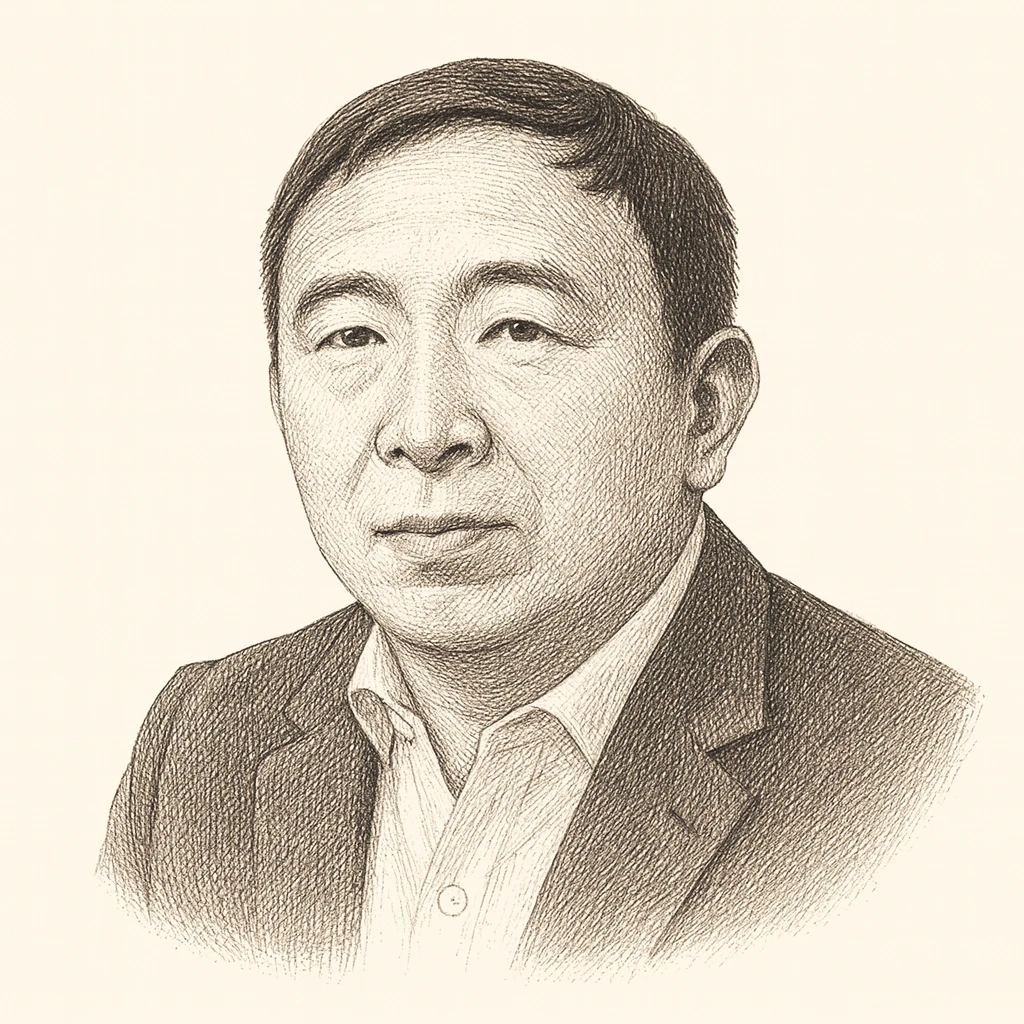
Andrew Yang emerged as a distinctive voice in American politics through his 2020 Democratic presidential campaign, where he built an unexpectedly durable following around a signature proposal he called the "Freedom Dividend"—a universal basic income of $1,000 per month for adult citizens. Yang framed this idea as a response to structural economic change, arguing that automation and technological displacement were eroding traditional employment and demanding a rethinking of how prosperity is distributed. His diagnosis drew on a broadly technocratic and futurist sensibility, presenting economic policy as a problem of measurement and adaptation rather than ideological combat, and popularizing the phrase "Humanity First" to signal a focus on human well-being amid economic transformation.
Central to Yang's political thought is skepticism toward conventional economic metrics, particularly gross domestic product, which he argued fail to capture measures of health, security, and quality of life. He advocated supplementing or replacing such indicators with broader well-being measures, reflecting an intellectual lineage that treats economics as a tool for human flourishing rather than an end in itself. This orientation, combined with his background as an entrepreneur and nonprofit founder, positioned him as a pragmatist who framed policy questions in terms of outcomes and incentives rather than partisan tradition.
After his presidential bid and a subsequent campaign for mayor of New York City, Yang moved toward an explicitly reformist critique of the two-party system. He co-founded the Forward Party, arguing that America's political dysfunction stems less from any single party's platform than from structural features that entrench polarization and discourage compromise. In this vein he became an advocate for procedural reforms such as ranked-choice voting and open primaries, contending that changing the mechanics of elections could reduce extremism and broaden voter choice.
Yang's influence lies less in a systematic body of theory than in his role as a popularizer who moved once-marginal ideas into mainstream discussion. Universal basic income, long confined to academic and libertarian-left circles, gained wider public attention through his advocacy, and his emphasis on institutional and electoral reform aligns him with a centrist, anti-polarization tradition that treats political fragmentation as a design problem to be engineered away. Critics question the feasibility and coherence of his proposals, while supporters credit him with reframing debates about work, technology, and democratic renewal.
Andrew Yang is associated with Pragmatic Centrist. See the archetype