
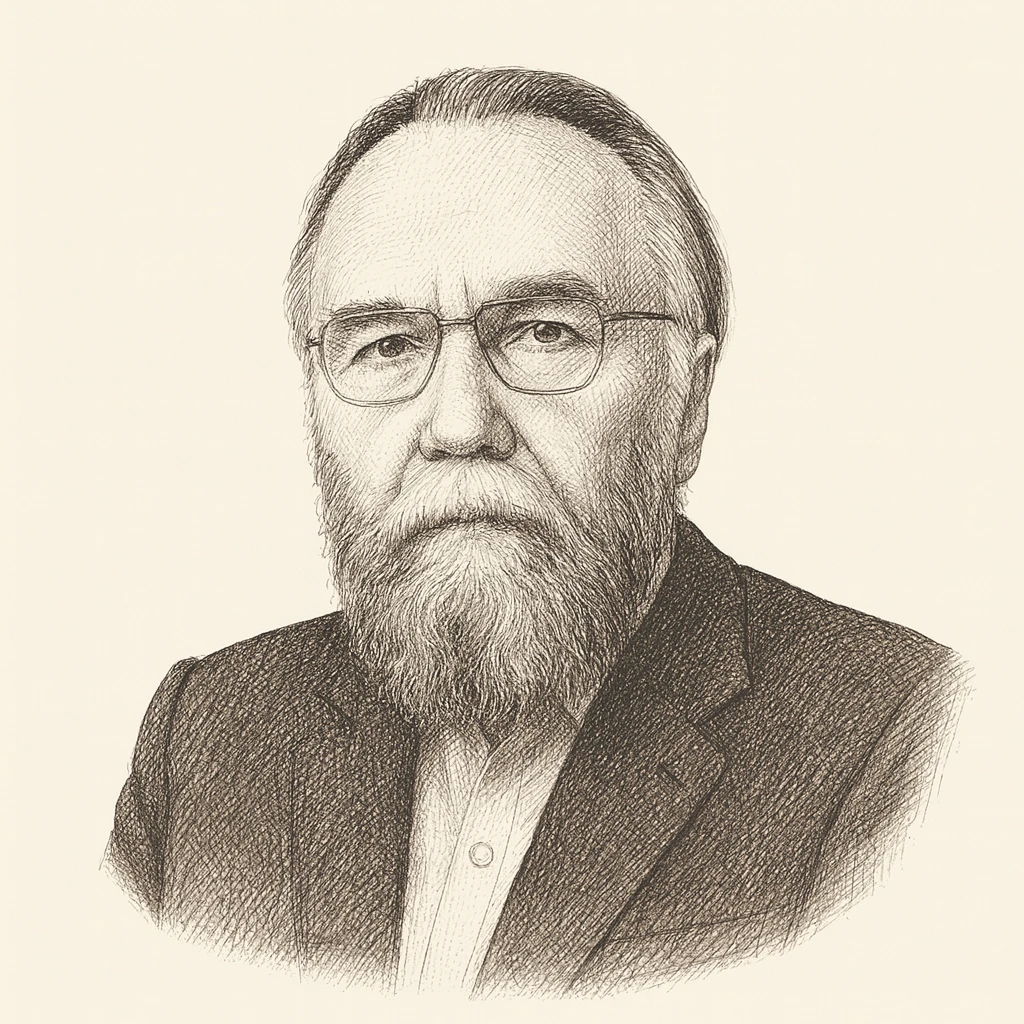
Aleksandr Dugin is a Russian political philosopher best known for reviving and radicalizing Eurasianism, a tradition holding that Russia is neither European nor Asian but the core of a distinct "Eurasian" civilization with a destiny opposed to the liberal West. Drawing on interwar Russian émigré thinkers, on European Traditionalists such as René Guénon and Julius Evola, and on figures of the "Conservative Revolution" including Carl Schmitt, Dugin frames world politics as a perennial struggle between land powers rooted in faith, hierarchy, and community and sea powers embodying commerce, individualism, and cosmopolitan liberalism. His book "The Foundations of Geopolitics" became widely read in Russian military and nationalist circles and helped popularize the idea of Russia as the pole of a multipolar order resisting American hegemony.
Dugin's later "Fourth Political Theory" argues that liberalism, communism, and fascism—the three great ideologies of modernity—have all failed, and that a new theory must be built beyond them, taking the ethnos and civilization rather than the individual, class, or race as its subject. He presents this as a rejection of both Western liberalism and totalitarian precedents, though critics note that his sources, rhetoric, and appeals to a mystical national community draw heavily on the far right and blur those lines. His thought is deeply anti-liberal and anti-modern, valorizing tradition, empire, spiritual authority, and strong sovereign power against pluralism and universal human rights.
Dugin's actual influence on Kremlin policy is contested and often exaggerated in Western commentary, but he is a genuine and prominent voice in Russian nationalist and Eurasianist intellectual life, and his ideas circulate among European and American radical-right movements. He has been an outspoken advocate of Russian territorial expansion and a militant hardliner regarding Ukraine: in 2014 he publicly called for killing Ukrainians in remarks on the Odesa violence—remarks that cost him his post at Moscow State University—and he has openly championed Russia's full-scale invasion of Ukraine since 2022; he has been sanctioned by Western governments. His work is best understood as an ambitious, deliberately provocative attempt to give authoritarian and imperial politics a metaphysical and geopolitical justification.
Aleksandr Dugin is associated with Reactionary Strongman. See the archetype