
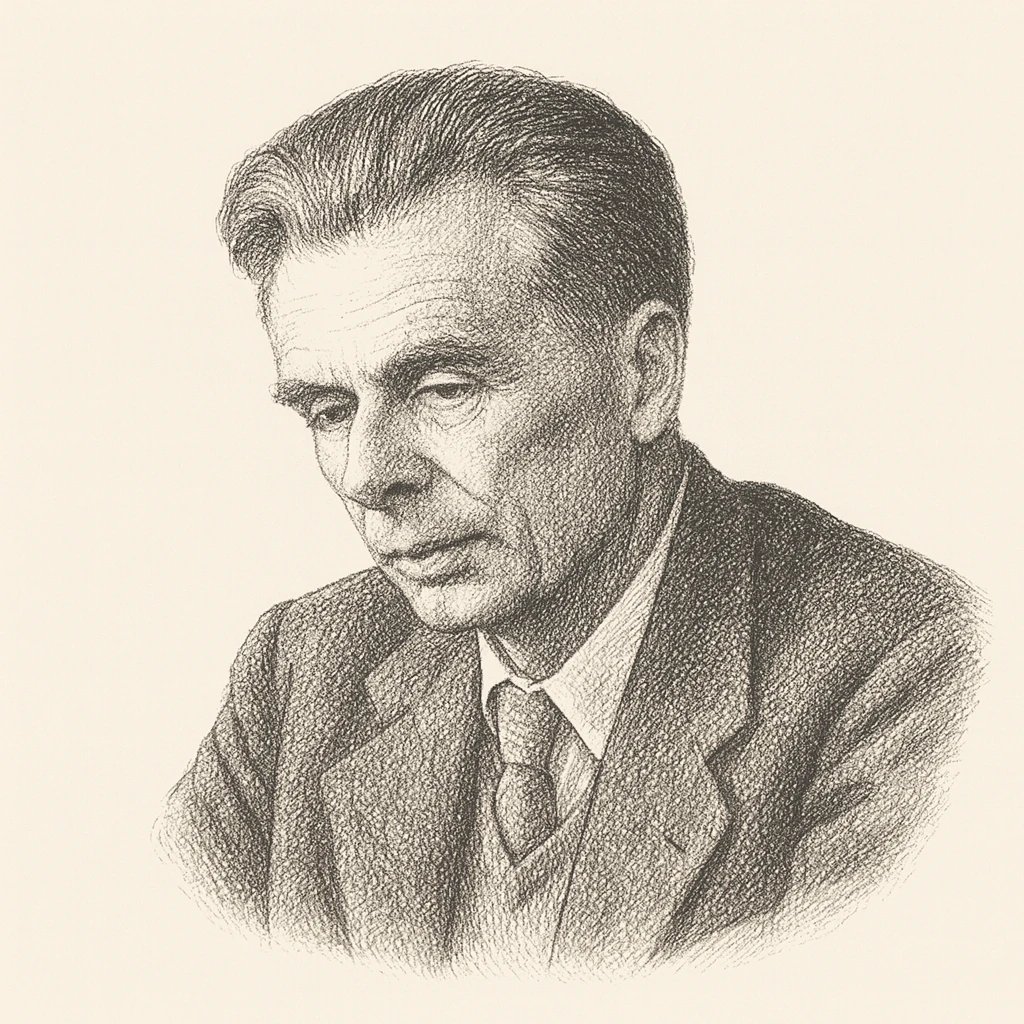
Aldous Huxley was a British novelist and essayist whose Brave New World envisioned a dystopia of pleasure, not pain—a world where humans are engineered for happiness and drugged into contentment. Born into a prominent scientific and literary family (his grandfather was Darwin's defender T.H. Huxley, his brother the biologist Julian Huxley), Aldous turned his intellect to social criticism.
Brave New World (1932) depicted a future where genetic engineering, conditioning, and the drug 'soma' eliminated suffering—and with it, freedom, love, art, and meaning. Unlike Orwell's 1984, Huxley's dystopia needed no totalitarian coercion; people chose their servitude. The book satirized the mass-production ethos of the era (the World State dates its calendar from Henry Ford) and warned that scientific management, consumer abundance, and psychological conditioning could produce contentment while hollowing out human dignity. Neil Postman, in Amusing Ourselves to Death (1985), argued that this vision of control through pleasure and distraction described modern media societies more closely than Orwell's vision of overt repression.
Huxley developed these political anxieties in later non-fiction. Ends and Means (1937) reflected his interwar pacifism and his argument that the means employed determine the nature of the ends produced. In Brave New World Revisited (1958) he argued that the trends he had feared, among them overpopulation, the concentration of power, and the refinement of propaganda and mass persuasion, were arriving sooner than he had expected, and he stressed the fragility of individual liberty against subtle, non-coercive control. His last novel, Island (1962), offered a utopian counterpart that treated some of the same themes more hopefully.
Huxley's later work also explored mysticism and consciousness. The Doors of Perception described his mescaline experiences; The Perennial Philosophy found common truths across religious traditions.
He emigrated to California, where he influenced the counterculture. He died on November 22, 1963, the same day as John F. Kennedy and C.S. Lewis. According to his wife Laura's account, in his final hours he asked in writing for LSD, and she gave him two injections.
Wondering where you land? Take the 4-minute assessment