
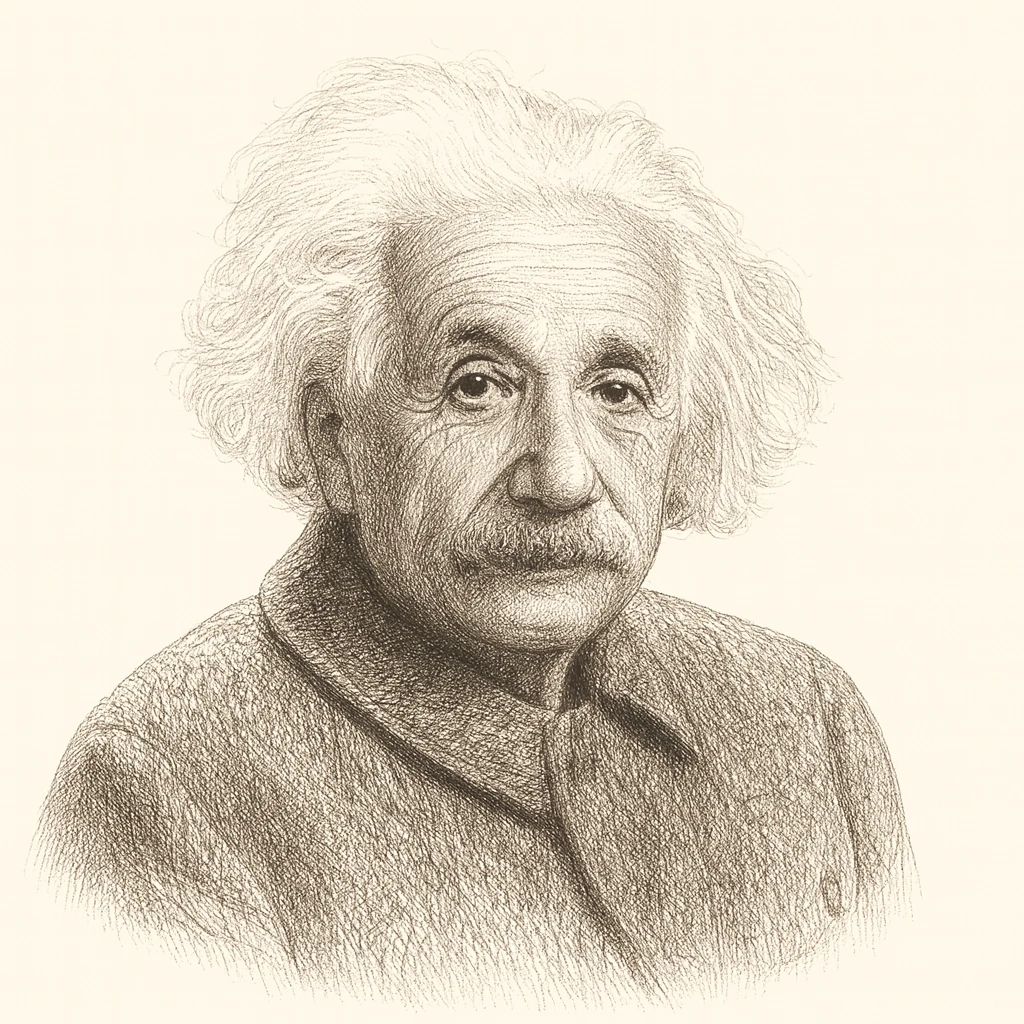
Albert Einstein was the most famous scientist of the 20th century, whose theories of relativity revolutionized physics and whose name became synonymous with genius. Born in Germany to a secular Jewish family, Einstein developed special relativity in 1905 and general relativity in 1915, fundamentally changing our understanding of space, time, and gravity.
Einstein was also a public intellectual who spoke on political issues. A pacifist who fled Nazi Germany in 1933, he had already opposed the militarism of the First World War. He reluctantly signed the 1939 letter to FDR recommending atomic research, fearing the Germans might develop the bomb first. After Hiroshima, he became an advocate for international control of nuclear weapons and world government, arguing that war was inevitable as long as sovereign nations held great power and that only a supranational authority could keep the peace. He helped lead the postwar movement of atomic scientists urging international control of atomic energy, and near the end of his life joined Bertrand Russell in a public appeal calling on governments to renounce war in the nuclear age.
Einstein supported socialist economics and set out his views in essay form: he argued that unregulated capitalism produced predatory competition and concentrated wealth and power, and that it crippled individuals by subordinating them to profit. He favored a planned economy oriented to social need and education for social responsibility, while cautioning that centralized planning risked bureaucratic overreach and must protect individual freedom.
He backed Zionism while criticizing Israeli treatment of Arabs and warning against narrow nationalism; he declined an offer to become president of Israel. He was an outspoken supporter of civil rights and a friend of Paul Robeson. His FBI file runs to more than 1,400 pages.
Einstein spent his final decades at Princeton, seeking a unified field theory he never found. He died in 1955, having transformed physics.
Albert Einstein is associated with Democratic Socialist. See the archetype