
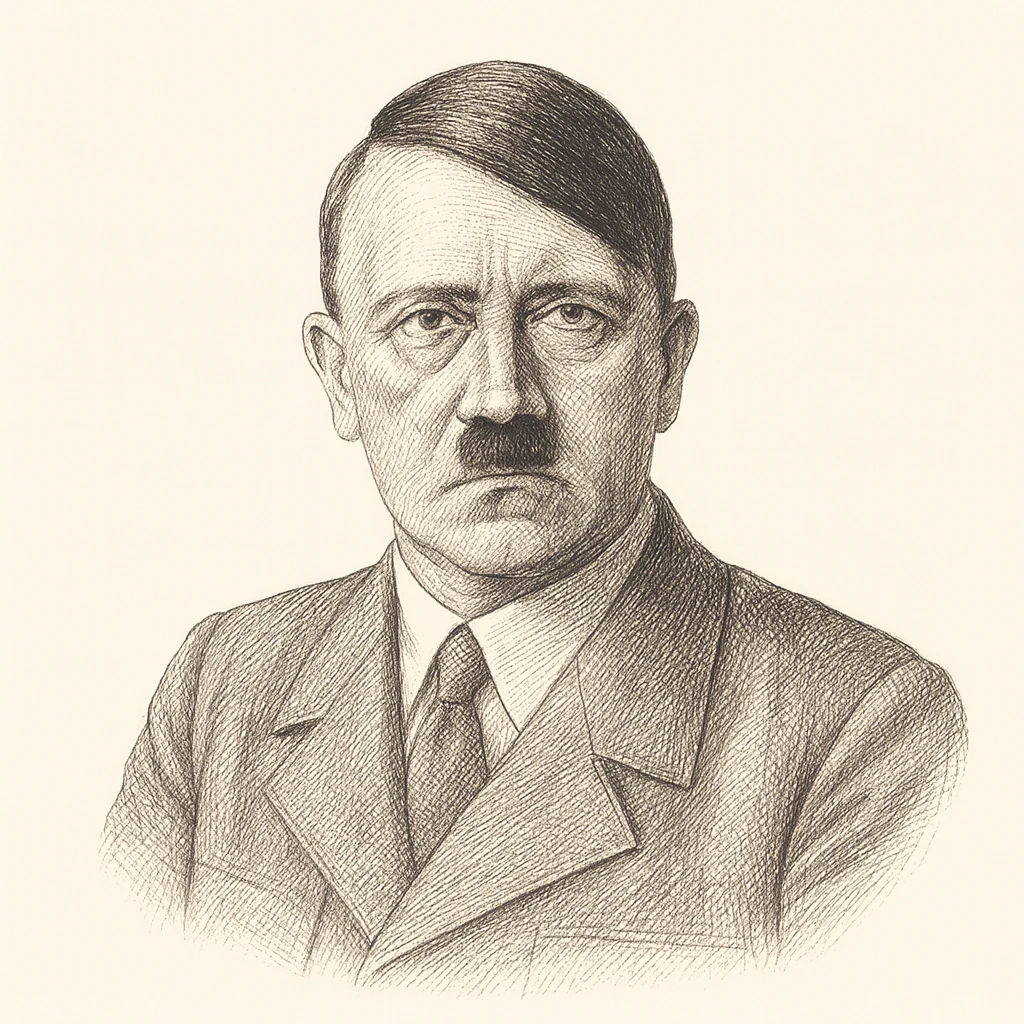
Adolf Hitler rose from failed artist and WWI corporal to dictator of Germany from 1933 to 1945. After the war, he joined the obscure German Workers' Party and transformed it into the Nazi movement through his oratory and his readiness to use the party's paramilitary SA against opponents. His failed 1923 Beer Hall Putsch led to imprisonment, where he wrote Mein Kampf.
Hitler's worldview, set out in Mein Kampf and his speeches, fused several currents already circulating in early twentieth-century Europe into a single militant creed. Its foundation was a racial theory of history: he cast politics as a permanent struggle between races, drawing on Social Darwinist ideas and pseudo-scientific antisemitism to portray Jews as an existential enemy responsible for both capitalism and Marxism. To this he joined the demand for Lebensraum, living space to be seized in eastern Europe, and the Führerprinzip, the principle that authority flowed downward from a single leader rather than upward from citizens. His ultranationalism defined the nation as a racial community, rejecting liberalism, parliamentary democracy, and class-based socialism alike while trading on grievance over the Treaty of Versailles.
Exploiting the Great Depression and the Weimar Republic's instability, Hitler became Chancellor in 1933 and swiftly dismantled democratic institutions. The Nazi regime combined totalitarian control, a cult of personality, and systematic terror against political opponents. The Nuremberg Laws stripped Jews of citizenship, followed by Kristallnacht and ultimately the Holocaust, the industrialized murder of six million Jews and millions of others, which put his racial doctrine into practice as state policy.
Hitler's aggressive foreign policy (remilitarization, the Anschluss, the seizure of Czechoslovakia) culminated in World War II. His invasion of the Soviet Union and declaration of war on the United States set Germany at war with Britain, the Soviet Union, and the United States at once. He committed suicide in his Berlin bunker as Soviet forces closed in, leaving much of the continent in ruins.
After the war, the International Military Tribunal at Nuremberg tried surviving Nazi leaders on charges that included crimes against humanity. Historians of the regime have divided over how its crimes came about, in the intentionalist–functionalist debate over whether they followed from Hitler's long-held aims or from the cumulative radicalization of competing Nazi institutions.
Adolf Hitler is associated with Reactionary Strongman. See the archetype